Hello Lab Muffin readers! Over the last couple of years you’ve probably noticed a few changes here – the launch of my YouTube channel, the growth of Instagram, my eBook debut, the gradual transition from shorter, more frequent content to longer, more in-depth posts, and the appearance of some larger sponsored projects. I’ve had lots…
Toner to leave skin feeling toned (whatever that means…)
I admit I don’t care for toners, but I’m always all over cleansers I can use both on my face and eyes. Because, why waste money on two products when the one will do?
But does this cleanser deliver? It’s made for sensitive skin after all, and this skin type can’t tolerate too much cleansing…
Key Ingredients In Vichy Purete Thermale 3 in 1 One Step Cleanser
Mineral Oil To Cleanse And Moisturize
I know what you’re thinking: “Isn’t mineral oil the devil of skincare?” Not really…
People don’t like it because it comes from petroleum (scary, huh?). What everyone ignores is that Cosmetic Grade Mineral Oil (the only type of mineral oil used in skincare products) undergoes a strict purifying process that removes all sorts of toxic impurities from it.
Cleanser: It works thanks to the like attracts like principle. Mineral oil attaches to the oils in your makeup and the excess sebum on your skin, melting them away. It’s super effective and can remove even waterproof makeup.
Moisturizer: It creates a barrier on the skin that slows down water loss, helping to keep your skin hydrated for longer.
One more thing: Mineral oil itself isn’t comedogenic. It causes pimples only when it traps impurities underneath your skin. As long as you remove every last trace of makeup, you shouldn’t experience breakouts.
P.S. Mineral oil is made in a lab, so it doesn’t contain any of the fragrant components that so easily irritate sensitive skin found in most oils (think lemon peel oil and geranium oil).
Isopropyl Myristate is here just to soften skin and thicken the texture. But I wanted to mention it in case it plays the same nasty trick on your skin: this thing is comedogenic.
High concentrations of Isopropyl Myristate never fail to break me out. This is why I always rinse off the cleanser, instead than leaving it on my skin like Vichy recommends.
I may miss out on the toning benefits, but those are insignificant anyway. A breakout is a worse evil…
P.S. Just because Isopropyl Myristate breaks me out, it doesn’t mean it will give you pimples, too. It’s usually oilier skin types that have a problem with it.
You need to use a cotton pad with this. At first, I was applying it with bare hands and washing it off with lukewarm water. But when I followed up with exfoliating pads, I realised half of my makeup was still on my skin! Ewwwww!
Since then, I always use a cotton pad. I need at least two for my entire face and an extra one for my eyes. It does a wonderful job at removing everything but the most stubborn of makeup without too much pulling and tugging.
If you’re wearing as much makeup as a Kardashian with a big dollop of waterproof foundation, you’ll better off with an oil cleanser like Squalane oil. It’s a cleanser on steroid but still super gentle.
Vichy Purete Thermale 3 in 1 One Step Cleanser is more for minimal makeup. You know what I’m talking about… sheer foundation, a dab of blush, non-waterproof makeup. It melts all that away while leaving skin soft and smooth.
If you’ve got sensitive skin and a compromised skincare barrier, a full face of makeup isn’t recommended, anyway. This cleanser will suit you fine.
Unless your skin is oily, you don’t have to wash it off. The cleanser will do a better job at moisturizing your skin if you leave it on.
Me, I need to get it off my skin. If your sebaceous glands pump out a bit too much oil here and there, this cleanser has the potential to break you out.
Overall, it’s a great option for women with sensitive skin who are looking for a gentle cleanser that removes the little makeup they have without pulling, tugging, and irritation.
Other skin types may find it wanting. But then, it’s wasn’t made with them in mind.
Get access to the “Pro Skincare Library” for exclusive skincare routine “cheat sheets” and tricks to help you navigate the beauty aisles jungle like a pro and immediately know what to pick off the shelves to achieve the gorgeous skin of your dreams – even when you’re drowning in an endless sea of skincare products.
Success! Now check your email to confirm your subscription and get access to the skin library.
We made a little trip out to Maui (see my previous travel guide for Maui here) for my college roommate’s wedding in September, and we happened to take advantage of the setting to do a little maternity shoot with the amazing Jess. I wanted to share some of these photographs because the setting was stunning, […] Read more…
The indie brand took the skincare world by storm thanks to its natural approach and beautiful packaging. How pretty do these bottles look on your vanity?
Sadly, the sleek packaging is also Herbivore’s downfall. Antioxidants are fickle: they degrade (and lose their effectiveness) a little every time they’re exposed to light and air. See-through bottles and jars aren’t the best way to house them. Just saying…
If you want to try them anyway, remember to keep your precious bottles in a dark drawer and close those jar lids fast. That’ll slow down the degradation process enough so you can finish your oils and creams before they go bad.
All clear? Good. Here are the best Herbivore skincare products:
Best For Anti-Aging: Herbivore Bakuchiol Retinol Alternative Serum ($54.00)
Bakuchiol is a natural ingredient derived from the Babchi plant that works like retinol: it decreases “wrinkle surface area and hyperpigmentation, with no statistical difference [with retinol]. The retinol users reported more facial skin scaling and stinging.” If your skin can’t tolerate retinol, or you’re looking for a natural alternative, Herbivore Bakuchiol Retinol Alternative Serum is worth checking out. It also has a bunch of exfoliating acids to get rid of dead cells, glycerin to hydrate skin and antioxidants to slow down premature aging. Just don’t keep the bottle under direct sunlight or its anti-aging benefits will evaporate into thin air.
Best For Dry Skin: Herbivore Emerald Deep Moisture Glow Oil ($48.00)
Herbivore Emerald Deep Moisture Glow Oil is my fave oil from the brand. Why? For starters, it has no fragranced oils that can irritate sensitive skin. Instead, it uses a blend of moisturising oils, like hemp and sunflower, that are rich in moisturising fatty acids. They strengthen the skin’s protective barrier, keep skin hydrated, and protect it from the onslaught of harsh weather and germs. Plus, a lot of these oils are loaded with antioxidants that help slow down premature aging.
Best Moisturiser: Herbivore Pink Cloud Rosewater Moisture Cream ($48.00)
Herbivore Pink Cloud Rosewater Moisture Cream has a luxe, oil-to-cream texture that blends like a dream and is a pleasure to use. It’s enriched with moisturizing natural oils and butters – think coconut, shea, and sunflower – to keep your skin soft and supple even in the harshest of weathers. These oils strengthen your skin’s protective barrier, so that moisture stays in and germs stay out. Herbivore sprinkled a few antioxidants in for good measure, but the jar packaging won’t keep them effective for too long. Close that lid quickly! P.S. Herbivore says the cream is suitable for all skin types, but I don’t agree. It’s too rich for oily skin.
What do you think are the best Herbivore skincare products? Share your picks in the comments below.
Take The Guesswork Out Of Skincare Shopping
Get access to the “Pro Skincare Library” for exclusive skincare routine “cheat sheets” and tricks to help you navigate the beauty aisles jungle like a pro and immediately know what to pick off the shelves to achieve the gorgeous skin of your dreams – even when you’re drowning in an endless sea of skincare products.
Success! Now check your email to confirm your subscription and get access to the skin library.
Liz Earle skincare – particularly the ever iconic Cleanse & Polish – has had pride of place in my bathroom since I began beauty blogging 8 years ago. It is one of those few brands that I fully trust and tend to splurge on frequently, especially should the product be and exciting which leads me to the new and very much limited edition Liz Earle Bergamot & Basil Collection; a range of 4 products that should you act now, will not only come in a beautiful gift box but also at a heavily discounted price.
The best way to describe the limited edition Liz Earle Bergamot & Basil fragrance is zesty and uplifting. It is a fresh combination of Egyptian Basil and Italian Bergamot which fuse together to create an invigorating blend that is perfect for perking up even the darkest of winter nights and days – or you of course could squirrel this particular launch away for next Summer should you wish. I can’t quite make up my mind if it is the power of suggestion at play, thanks to the cute illustrations on the packaging but at times, the limited edition Liz Earle Bergamot & Basil scent does have a certain "lime" like note which I personally rather enjoy.
The limited edition Liz Earle Bergamot & Basil Collection contains a few fan favourites all complete with the beautiful new fragrance; the aforementioned skincare staple that is Liz Earle Cleanse & Polish (150ml), as well as Liz Earle Skin Tonic (200ml) are decorated both with the new scent and packaging – both of which I find are great for all skin types and needs. For the body there is the Liz Earle Botanical Body Cream (200ml) and the Liz Earle Hand Repair (50ml), again scented with Bergamot and Basil and presented in freshly adorned packaging.
Now if you are currently planning ahead and perhaps not adverse to stocking up on Christmas presents a little earlier than most, the good news is that the limited edition Liz Earle Bergamot & Basil Collection is available via QVC and not only features the above products but also: the original Liz Earle Cleanse & Polish (200ml), two Liz Earle Cleansing Cloths and Liz Earle Skin Repair Moisturiser (50ml), all neatly presented in a gift box and for the rather impressive price of just £52.96 (contents worth over £126).
You can find the Liz Earle Bergamot & Basil Botanicals Gift Set here – link.
It’s already that time – fourth year medical students are getting ready to interview at programs across the country, and residency interview and pre-interview attire is again a hot topic! I posted about residency interview attire in the past but I wanted to give my old post a facelift by sharing some new links to […] Read more…
Anyone dabbling with anti-aging skincare products is bound to hear about two active ingredients again and again:
Retinoid and retinol.
They sound similar, and if you guessed that they’re both forms of vitamin A, you’d be right.
But is there actually a difference between them? And most importantly, what can they do for your skin?
In this tutorial, you will learn:
What is a retinoid and what is retinol
All the types of over-the-counter retinoids
All the types of prescription retinoids
Which skin concerns they’re best for, plus my product suggestions
Plus, I’ve got a free cheat sheet for you to download at the end of this article!
Retinoid vs Retinol
Lixirskin Night Switch Retinol 1% and Retin-A Cream.
The terms “retinoid” and “retinol” are often used interchangeably, but they’re not quite the same thing.
Retinoid is an umbrella term for the entire FAMILY of vitamin A derivatives, including both over-the-counter products (which are the gentlest) and prescription treatments (which are the most potent). The different types of retinoids include:
Retinol esters
Retinol
Retinaldehyde
Retinoic acid esters
Adapalene
Tretinoin
Tazarotene
Trifarotene
Isotretinoin
In general, the regular use of retinoids can give you improvements such as fewer fine lines and wrinkles, firmer skin, more even skin tone and fewer breakouts.
Retinol is one specific type of retinoid—the most common and proven retinoid sold over-the-counter. Dermatologists often refer to retinol as the “gold standard” anti-aging ingredient because not only is it widely available, it also has decades of research behind it to demonstrate its effectiveness.
So does that mean you should just stick with retinol? Or is it worth trying one of the other retinoids?
To answer that question, you need to understand how retinoids convert to active vitamin A!
The Retinoid Conversion Process
The retinoid conversion process.
No matter which retinoid you choose, your skin can ONLY use the active form of vitamin A, retinoic acid.
Retinoic acid binds to the retinoid receptors in our bodies (of which there are three types), where it normalizes cellular renewal and cellular repair processes. This is how retinoids work their magic on lines, dark spots and more!
The strongest retinoids, including tretinoin and isotretinoin, are pure retinoic acid. So they are the most biologically active retinoids, and will start to change your skin right away (although the side effects can be significant). This is why retinoic acid treatments are available by prescription only.
Gentler, over-the-counter retinoids have to be converted into retinoic acid by the enzymes in our skin before we can actually get their benefits. This can happen in one, two or three steps.
One step: Retinaldehyde is the direct precursor to retinoic acid.
Two steps: Retinol first converts to retinaldehyde, and then from retinaldehyde into retinoic acid.
Three steps: Retinol esters convert to retinol, then from retinol to retinaldehyde, and finally from retinaldehyde to retinoic acid.
The closer the compound to retinoic acid, the more readily it converts—and the more effective it becomes.
But keep in mind that the conversion rate can also vary depending on the individual (some people convert retinoids into retinoid acid more quickly than others!). Other factors include the concentration of the active ingredient and whether or not it has degraded (some retinoids are unstable).
Now, let’s take a closer look at each type of retinoid and what it can do.
Types of Over-the-Counter Retinoids
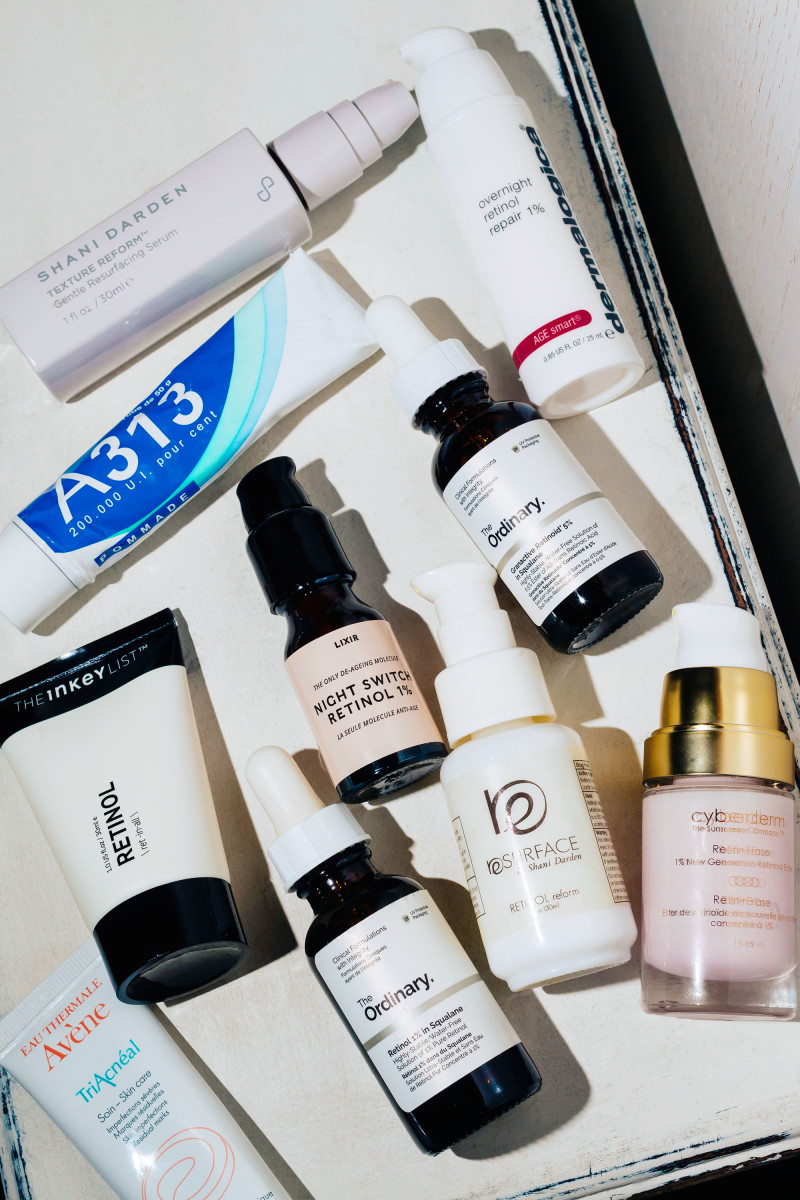
Over-the-counter retinoids from Shani Darden, Dermalogica, The Ordinary, CyberDerm, Avène, The Inkey List, Lixirskin and A313.
Retinol Esters
Retinol esters are the mildest types of retinoids, because they need to be converted three times within our skin before they become active. This makes them a good choice for sensitive, reactive skin and anyone new to retinoids, as they are unlikely to cause any irritation.
But not all retinol esters are made equal. The most effective is retinyl propionate, which has been shown in higher concentrations to reduce wrinkles and pigmentation. Retinyl palmitate is your next best choice, with some benefits for photodamage and skin thickening (although it’s worth noting Dr. Leslie Baumann believes it is “topically ineffective”).
The other retinol esters—retinyl acetate and retinyl linoleate—are weaker and best used in combination with each other and/or stronger retinoids.
Shani Darden Retinol Reform (reviewed here) is a cult-favourite serum with five percent each of retinyl propionate and lactic acid. (Confusingly, the website lists “retinol” as the active ingredient, but as per the box, it’s actually retinyl propionate.)
A313 Vitamin A Pommade (reviewed here) is another cult retinoid, an ointment with retinyl acetate, retinyl palmitate and retinyl propionate. (It’s actually quite strong!)
Vivant Skin Care Derm-A-Gel is a retinyl propionate serum that also has kojic acid, lactic acid and niacinamide.
Joanna Vargas Daily Serum is a hydrating and gentle anti-aging serum with retinyl palmitate, hyaluronic acid and vitamins C and E.
Retinol
Retinol, the most popular over-the-counter retinoid, goes through two conversions before it becomes active. That means you’re getting a more effective form of vitamin A than the retinol esters. In fact, retinol has been proven to induce similar skin changes as retinoic acid—it may just take a little longer to get there.
The downside is that retinol can be drying and irritating for some people, although not as much as stronger retinoids like tretinoin. However, even sensitive skin can be trained to tolerate retinol, believes Dr. Dendy Engelman. (It’s also worth noting that the inactive ingredients in a formula could be triggering irritation, not necessarily the retinol itself.)
Products to try:
Retinaldehyde
Retinaldehyde, also known as retinal, is directly converted into retinoic acid by our skin. So it works faster than retinol, and may even be more effective (it just doesn’t have as much research behind it). Like we saw with retinol, retinaldehyde can also produce skin changes that are comparable to retinoic acid.
Similar to retinol, you can get some dryness and irritation from using retinaldehyde, but not on the same level as you would from a pure retinoic acid.
Products to try:
Retinoic Acid Esters
Retinoic acid esters are a new generation of retinoids that are cropping in more and more products. Although we don’t have a lot of data on them yet, they show promise for being more active than retinol, without the irritation.
One type of retinoic acid ester is retinyl retinoate. It breaks down into both retinoic acid and retinol, making it active within one step (just like retinaldehyde), as well as more active later on, once the retinol is converted. So far, studies show that retinyl retinoate is more effective than retinol for treating wrinkles. It also works on mild to moderate acne by fighting bacteria and reducing sebum production.
The other type of retinoic acid ester is hydroxypinacolone retinoate (HPR), which you might be familiar with as “granactive retinoid” (a term popularized by The Ordinary). Granactive retinoid is simply a complex that includes HPR, the active, in a 1:10 ratio with a solvent, dimethyl isosorbide. So when you see a percentage of granactive retinoid being quoted, be aware that you need to divide by 10 to get the actual concentration of HPR.
Since HPR binds directly to retinoid receptors, its activity is similar to pure retinoic acid. But not only is it less irritating than tretinoin, it is also less irritating than even 0.5 percent retinol. Nearly all the research comes from the manufacturer, which found that HPR significantly reduces wrinkles, age spots and sun damage. Another study found it has greater levels of gene expression than retinol.
Note: HPR is available over-the-counter in the US, UK and Australia, but no longer sold in Canada, where it is now considered a drug.
Products to try:
Adapalene
Adapalene, which recently became available over-the-counter in the US, is a synthetic retinoid that selectively binds to some (but not all) of the retinoid receptors in our skin. That means it does not need to be converted to retinoic acid before it becomes active.
Although it’s less irritating than tretinoin, adapalene can cause dryness, flakiness, redness and stinging, especially during the first few months of treatment.
Products to try:
Types of Prescription Retinoids
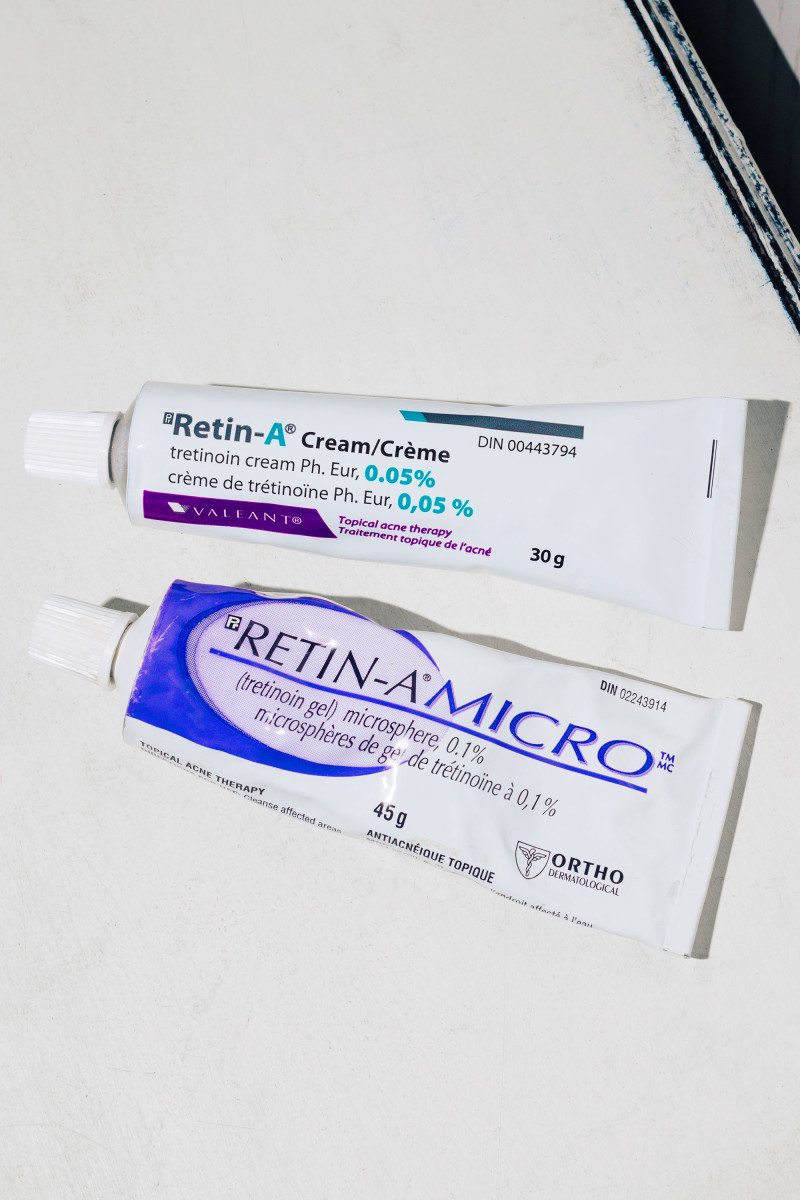
Prescription Retin-A Cream and Retin-A Micro.
Adapalene
Adapalene is also a prescription medication. While the 0.1 percent formula is sold over-the-counter in the US, you’ll need a prescription for the stronger 0.3 percent concentration. In the UK, Canada and Australia, all concentrations of adapalene are only available by prescription.
Again, adapalene only targets specific retinoid receptors, unlike tretinoin and isotretinoin. It is most effective as a treatment for acne, but can also help with wrinkles and sun damage. It is also associated with less irritation than tretinoin.
Tretinoin
Often known by the brand name Retin-A, tretinoin is pure retinoic acid. So it doesn’t need to be converted when it comes in contact with your skin, and gets to work immediately.
Unfortunately, there’s a catch. Irritation, dryness, peeling, redness and even swelling are common side effects of tretinoin. There’s also a risk that tretinoin-induced inflammation could lead to hyperpigmentation.
Tazarotene
Tazarotene is the strongest topical retinoid, and like adapalene, it is receptor-selective. In other words, it only binds to some of our retinoid receptors, where it becomes immediately active (no conversion steps necessary).
Like the other prescription retinoids, tazarotene is associated with dryness, redness and irritation, particularly when beginning usage. Due to its potency, it tends to be more irritating than adapalene.
Trifarotene
Trifarotene is the newest retinoid on the block. It’s different from adapalene and tazarotene because it targets just one retinoid receptor (the most common one found in our skin). As a result, it is gentler than the other prescription retinoids.
So far, it is being touted as a medication for acne. Research indicates that it reduces inflammatory acne lesions both on the face as well as the chest, shoulders and back.
Compared to tretinoin and even adapalene, it is not as irritating. So if you have sensitive skin and have had trouble tolerating prescription acne treatments, it’s definitely worth a shot.
Isotretinoin
Isotretinoin, also known as Accutane, is a prescription retinoid that you take orally. Like topical tretinoin, it consists of pure retinoic acid.
However, isotretinoin is linked to many serious side effects. Among them are cheilitis, tiredness, eczema, headaches, joint pain, bone disorders and anemia. Users are also at higher risk for depression, suicide and inflammatory bowel disease.
Conclusion + Free Cheat Sheet
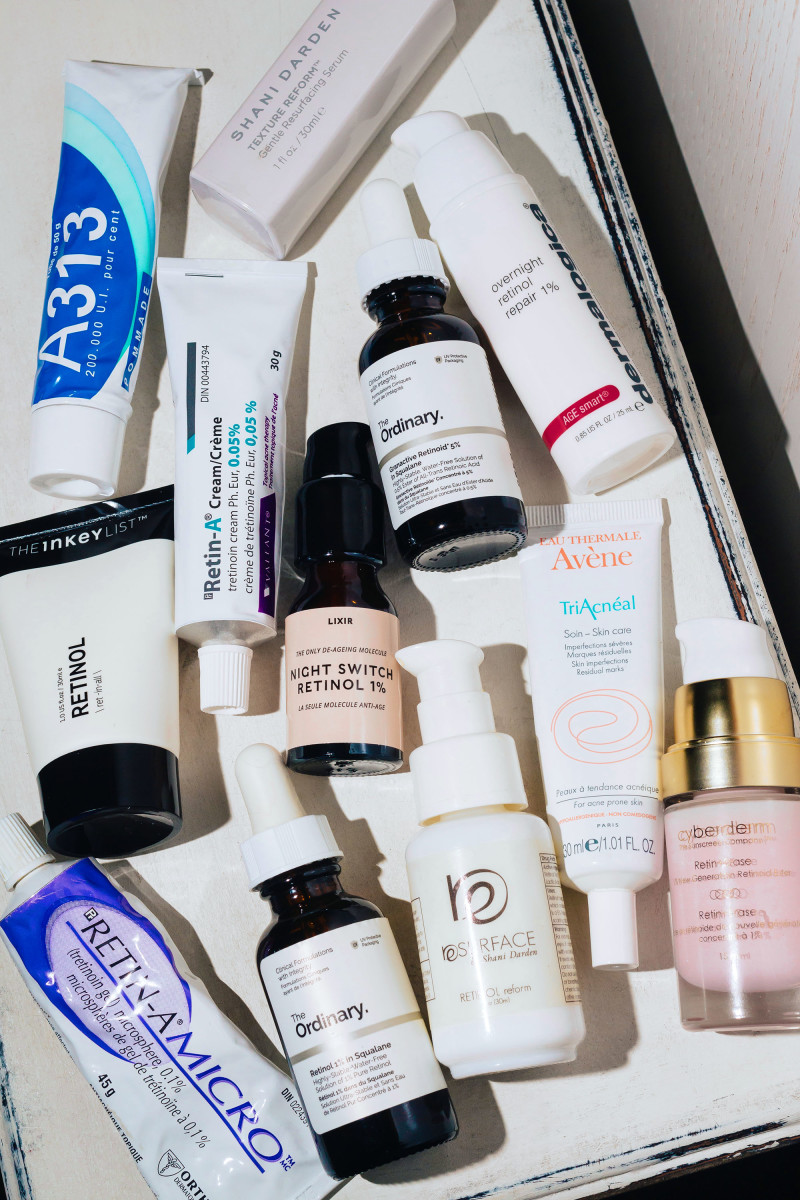
Over-the-counter and prescription retinoids.
Now you know the difference between retinoids and retinol, as well as ALL the different members of the retinoid family.
It’s a lot to remember—which is why I created the Types of Retinoids Cheat Sheet. Just click below to download it so you don’t forget any of the retinoids, and have a handy reference when checking your skincare ingredients lists. (It’s FREE!)
Personally, I’m a big believer in over-the-counter retinoids, since research has shown you can get comparable results to prescription treatments, without all the irritation.
In my experience, it’s definitely true. I’ve tried tretinoin in the past, but my skin is a lot happier with retinoids like A313 (reviewed here) and Shani Darden Retinol Reform (reviewed here). Even though they only contain retinol esters, the weakest types of retinoids, they make my skin clear, plump and even-toned—with none of the angry, flaky skin I always struggled with on Retin-A.
Let me know if you’ve tried a retinoid yet, and what it’s done for your skin!
Shop Editor’s Picks
What’s your favourite retinoid? And what results have you noticed?
I could go on and on. But you get the gist. I get asked what makes one skincare ingredient better than another all the time.
It’s a question that’s impossible to answer. You know why? Because “better than” doesn’t mean anything. Or better yet, it means whatever you want it to mean.
If you’re into natural skincare, you believe than plant extracts are better than anything made in a lab – no matter how many studies proving the opposite I show you.
If you’ve got oily skin, you’ll think hyaluronic acid is a better moisturiser than coconut oil because it doesn’t break you out – and yet, for someone else, coconut oil is the best moisturiser ever.
If you’re looking for instant results, you’ll think silicones are better than retinol because they reduce the look of your wrinkles straight away and without the irritation – even though once you wash them off, your wrinkles are still as deep a before.
In other words, what makes a skincare ingredient better than another is the wrong question to ask. The right one is, “What skincare ingredient is better for YOUR unique skin type and needs?”
The answer depends on a mix of science and personal preference:
Effectiveness
The main criteria I use when deciding what skincare products to buy is effectiveness. Does the ingredient do what you want it to do and are there studies to prove it?
So, which one is better: retinol or silicones? You could argue that retinol is the better one because it works long-term, but the answer isn’t so clear cut.
If you’re looking for a quick fix for your friend’s wedding, retinol won’t cut it. If you expect silicones to fade away your wrinkles for good, you’ll be disappointed.
Instead than comparing ingredients, ask yourself what results you want to achieve? Then, look for ingredients that can deliver that.
P.S. I personally believe that reducing wrinkles for good is better than masking them. But I know that takes time. So, I use both.
Glycolic acid is a smaller molecule, meaning it does the exfoliating job better and faster than lactic acid. It follow that glycolic acid is better than lactic acid, right?
Not so fast. Glycolic acid may be more effective, but it’s also harsher. If you’ve got sensitive skin, it can irritate it real bad. How does that make glycolic acid better?!
It’s not just how well an ingredient performs. It’s how well your skin can tolerate it. Some ingredients are too harsh or comedogenic for certain skin types. Get to know yours, so you can avoid what it doesn’t like.
If it’s expensive it’s better, right? Case in point, mineral oil vs Argan oil.
Argan oil is rare because it’s extremely expensive and time-consuming to produce. The price reflects that.
Mineral oil, on the other hand, is derived from petroleum. Even though it undergoes a strict purifying process to remove all toxic impurities, it’s still super cheap to produce.
That’s why you’ll find mineral oil instead than Argan oil in most moisturisers at the drugstore. But is one really better than the other?
If you’re on a budget and in need of a moisturizer for your dry skin, mineral oil will do the job just fine. Heck, it’s one of the most moisturizing substances on this planet!
If you can afford to splurge on a bottle of pure argan oil, go ahead. But don’t fool yourself – you’ll get the same results.
Expensive doesn’t equal better. Cheap ingredients can perform wonders, too.
Sometimes, which skincare ingredient is better than another simply comes down to personal preference.
Maybe you don’t want to use ingredients that are derived from animals. Or you’re trying to be more eco-conscious and prefer to stick to natural ingredients. Or you simply may find certain oils and waxes too greasy for your tastes.
That’s totally fine. You shouldn’t compromise your values and preferences to take proper care of your skin. But that doesn’t mean the ingredients you like to use are better than the ones you avoid – they’re just better for YOU.
What Makes One Skincare Ingredient Better Than Another?
So, how do you figure out which skincare ingredients are better for your own needs? Here’s a quick checklist:
Effectiveness: Does the ingredient does what you want it to do and are there studies to prove it?
Skin type: Is this ingredient suitable for your skin type?
Price: Is this ingredient affordable or should you look for a cheaper alternative that works just as well?
Personal preference: Do I feel good about using this ingredient?
If you can say yes to all these questions, that skincare ingredient is better than another. FOR YOU.
How do you choose which skincare ingredients are better for your needs? Share your thoughts in the comments below.
Take The Guesswork Out Of Skincare Shopping
Get access to the “Pro Skincare Library” for exclusive skincare routine “cheat sheets” and tricks to help you navigate the beauty aisles jungle like a pro and immediately know what to pick off the shelves to achieve the gorgeous skin of your dreams – even when you’re drowning in an endless sea of skincare products.
Success! Now check your email to confirm your subscription and get access to the skin library.
This attractive plant has gorgeous pink flowers and would probably look great in a bouquet, but I’m guessing you won’t find it in any florist shops. This pretty slice of nature just happens to be categorized as a weed.
Like most weeds, Epilobium Angustifolium, (also Chamaenerion Angustifolium and Chamerion Angustifolium) is a hardy plant that is real good at surviving without any special prodding or pampering from humans.
Do you ever wish you could go back in time, when your skin was flawless and glowy, without a wrinkle in sight? Retinoids are the fairy godmothers that can grant…
 Hello Lab Muffin readers! Over the last couple of years you’ve probably noticed a few changes here – the launch of my YouTube channel, the growth of Instagram, my eBook debut, the gradual transition from shorter, more frequent content to longer, more in-depth posts, and the appearance of some larger sponsored projects. I’ve had lots…




 Dawn Siler