Pictured: One of the latest batches of my Rose and Soapnut Slow Beauty Cleansing Milk. This is partly experimenting with a few ingredients combos, and partly testing the limits and capabilities of this particular emulsifier. I’ve been using this particular ingredient combo for most of this year and it has been performing beautifully. The best part? It’s relatively easy to make.
If you’ve been following me on Instagram, you’ve probably already seen a few batches underway. As a matter of fact, I’m sharing this how-to with you due to numerous requests from lovely Insta-folks.
This formula utilizes a COSMOS certified and organic emulsifier (and oil thickening agent) that can be used either hot or cold (which is kind of cool if you ask me).
Today I’m going to show you how I made this as a simple cold process emulsion. Spoiler alert: there’s a reason the title includes ‘Slow Beauty’.
I learned the hard way you don’t want alcohol in your skincare.
I was 15 years old. Just as beauty obsessed as I am now. But, a lot less savvy.
I had just started to put together a skincare routine for my skin and had heard toner was a must (I later learned it’s not). I had no idea how to choose one, so I’d just go with whatever was marketed formulated for teenagers.
Slowly, my skin started to become drier. Even if I switched toner, my skin wouldn’t improve. I figured dry was my skin type. Bummer!
Then, one day, I ran out of toner. For some reason, I didn’t buy one for a few days. Something weird happened. My skin wasn’t dry anymore. It had healed!
It seemed like a miracle then, but now that I’m older and wiser (at least, when it comes to skincare), I know my toners were to blame. Back then, all toners for teenagers were laden with alcohol!
Once I learned my lesson, I started looking for alcohol-free toners. But, wait, what’s that?! When I checked the label, alcohol had somehow sneaked its way in there, too. How could these brands break the rules like this?
They weren’t. You see, there are two types of alcohol: the bad kind that should have you run in the opposite direction and the good kind that keeps your skin soft and smooth. Let me explain:
The Bad Kind Of Alcohol
What does it do?
This type of alcohol is like a solvent:
It thins thick formulas (it’s usually what gives chemical sunscreens their super lightweight textures)
It helps deliver skincare actives deeper into your skin
It gives skin a tight feeling and constricts the pores
These alcohols seem innocuous enough, don’t they? But that tight feeling is a sign of dehydration. Alcohol eats up your skin’s protective barrier, leaving your skin dry and irritated.
That’s also how they help other ingredients better penetrate your skin, by the way. Once this barrier is damaged, everything can get through it.
FYI, the latest research shows that the drying effects of alcohol can be counteracted with a good moisturiser. As long as that toner or moisturiser you’re eyeing also has moisturising ingredients, you’re probably going to be fine.
How Do You Identify It On The Ingredient List?
Look out for these bad boys:
Alcohol Denat
Benzyl Alcohol
Ethanol
Ethyl Alcohol
Isopropyl Alcohol
Methanol
SD Alcohol.
If they’re low on the ingredient list, you’re cool. If they’re high, check if the product also has moisturising ingredients. If it doesn’t, or your skin is particularly sensitive, leave it on the shelf.
The Good Type Of Alcohol
What Does It Do?
This type of alcohol is called fatty alcohol. It’s the complete opposite of his bad sibling. If the latter is drying, the good type is moisturizing:
It thickens thin formulas (it’s what gives body butters their rich texture)
It moisturizes your skin, leaving it softer and smoother
There are other alcohols that aren’t fatty but are still very hydrating:
Butylene glycol
Propanediol
These are friends. Don’t be scared of them.
So, what does alcohol-free mean?
Let’s rewind back to when I was scrutinizing skincare labels to avoid anything with a drop of alcohol in it. I’d pick up a bottle labelled alcohol-free and then realise it had cetyl alcohol or butylene glycol. Surely, this was against the law?
Nope. Alcohol-free means it doesn’t have a drop of the bad type of alcohol (you know, alcohol denat and its ilk). The good one is allowed.
Cos it’s not fair to paint the goodies with the same brush as the baddies.
Mystery solved!
For more misleading marketing terms that mean nothing, click on the image below and download the “Misleading Skincare Claims Cheatsheet”:
✕
More Misleading Claims!
Sign up to my newsletter to receive the “Misleading Cosmetic Claims Cheatsheet” and find out more ways beauty brands trick you into buying their products.
Success! Check your email to confirm your subscription, so I can send you your free copy of “3 Misleading Cosmetic Claims.”
Do you always look for alcohol-free products, too? Share your thoughts in the comments below.
Take The Guesswork Out Of Skincare Shopping
Get access to the “Pro Skincare Library” for exclusive skincare routine “cheat sheets” and tricks to help you navigate the beauty aisles jungle like a pro and immediately know what to pick off the shelves to achieve the gorgeous skin of your dreams – even when you’re drowning in an endless sea of skincare products.
Success! Now check your email to confirm your subscription and get access to the skin library.
I’ve had a lot of requests for a video for teenage skincare, and a lot of questions about acne. So here are my top 5 tips for acne-prone skin! It includes an appearance by Baby Goth Michelle, and some hectic eyebags courtesy of my post-Europe insomnia (one month and counting).
Related posts and videos that you might also be interested in:
Do you know how to determine your skin type? Cos if you don’t, that could be the source of all your skincare problems. Here’s what I mean…
I remember the day I bought my first moisturizer. I spent ages exploring all the little jars and bottles on the shelves of my local supermarket, trying to decide which one to bring home with me. I felt so grown up.
I had no idea what I was doing.
In the end, I went home with a jar of Nivea cream. I picked it because it was popular… and one of the few creams my broke teenage self could afford.
For a while, it worked. My skin was so soft! When the breakouts started happening, I blamed it on hormones… (we all know they go crazy during adolescence, right?).
Until one day, I ran out of Nivea Creme. So I reached out for a cream in my mum’s skincare stash and used that for a few days (Sshhhh! Don’t tell her!). What do you know, the breakouts disappeared.
I didn’t think anything about it then. But over the years, I saw a clear pattern emerge. Whenever I used Nivea Creme, a bunch of pimples would spring up all over my face. Whenever I stopped, those damn pimples stayed away. Coincidence? I don’t think so.
It took m a while to realise it but Nivea Creme was too rich for my combination skin type. And when you use a cream (or any other skincare product for that matter) that’s not suitable for your skin type, all kinds of nasty stuff happens. Breakouts. Dryness. Flakiness. Stinging and burning. It ain’t pretty.
If you want to take good care of your skin, and choose the right products to help it stay healthy and younger-looking, you need to determine your skin type first.
But how the heck do you do that? It’s not like there’s just one skin type. It could be oily, dry, normal, sensitive or a combination of the above.
Don’t worry, you don’t need to figure it out alone. Here’s a quick guide to help you determine your skin type:
The universe has blessed you, you lucky gal! Enjoy it!
The Symptoms
No shiny patches, no flakiness, no irritation, nothing to report.
You heard about breakouts, but don’t even get the occasional pimple.
You’re pretty sure you have pores, but you’ve never seen them.
Your skin looks and feels… well, normal.
The Cure
Whatever it is you’re doing, keep doing it. You’re on the right track. The only thing I recommend (if you ain’t doing it already) is to use formulas rich in antioxidants. Skin can never get enough of them.
Your sebaceous glands are workaholics. They don’t like taking breaks, and don’t know what holidays are. They just keep pumping out oil like there’s no tomorrow.
The Symptoms
Your skin is shinier than a frying pan.
Your pores are so big, they can be seen from Mars (ok, maybe not, but it definitely feels that way).
Breakouts galore! Whiteheads, blackheads, pimples… you have them all.
Your skin ages more slowly and you get less wrinkles – there had to be something positive about it, right?
The cure
Keep oil production under control without drying out skin. Astringents and alcohol-toners are out. Your new best friend is salicylic acid. It exfoliates the surface of the skin and unclogs the pores, reducing shine and breakouts. Twice a week, use an oil-absorbing clay mask to give it a helping hand. And keep your skin hydrated with oil-free moisturizers that give skin a burst of moisture without adding more oil.
Your sebaceous glands are so lazy. They know they should produce more oil to keep skin naturally moisturized and protect it from harsh weather and pollutants, but they just can’t be bothered to.
The symptoms
Skin flakes like a bad attack of dandruff, and why is it always so rough?
You wish you didn’t have to wash your face, it feels so tight and uncomfortable afterwards.
Inner glow? What’s that? You skin is as dull as dishwater.
You’re no stranger to itchiness and redness.
You develop wrinkles, and deeper ones too, earlier than your oily-skinned girlfriends. So unfair!
On the plus side, your pores are so small, you’re not even sure you have them.
The cure
If you determine your skin type is dry, your skin is badly in need of moisture. Treat it with a hydrating serum infused with humectants, like hyaluronic acid, that attract water into the skin. Then, lock them in with oil-based, occlusive moisturizers, or they’ll just evaporate into thin air! When your skin needs an extra dose of TLC, turn to a moisturizing sheet mask. Those never disappoint! And don’t forget to exfoliate with glycolic acid. It gets rid of the roughness and dullness, and hydrates skin, too.
Your sebaceous glands so aren’t team players. They all want to do their own thing. Some produce too much oil. Others too little. They just refuse to compromise and cooperate. Sighs
The Symptoms
Your t-zone shines brighter than a diamond, but your cheeks dry out and flake like a pie crust.
You hope it’ll never happen again, but you know the next breakout is just around the corner.
Those pores on your t-zone are getting more and more visible.
The Cure
You need to get those sebaceous glands to work together to balance out oil production. Your best bet is to combine care regimes for dry and oily skin types. So oil-free moisturizers and oil-absorbing masks on the t-zone, and occlusive, richer formulas and hydrating sheet masks on the cheeks. I know, it’s a pain. But, it works.
Your skin’s protective barrier is under attack. Freezing cold weather, harsh skincare products, and unprotected sun exposure are harming it, breaking it open in places. Now, germs, pollutants, and other nasties can get in and wreak havoc.
The Symptoms
Your skin is always throwing a tantrum. Everything it comes in contact with seems to sting it, burn it, make it itch, or turn it red. Ouch!
Your skin tends to be as dry as the Sahara.
Your skin is often red and flushed, and not in the I-just-went-for-a-stroll-in-winter kind of cute flushed.
The Cure
Did you determine your skin type is sensitive? Rebuild that protective barrier, fast! Use products with skin-identical ingredients, ie the bricks that make up that protective barrier, like ceramides, fatty acids, amino acids, and lecithin. Give it a soothing breakfast of chamomile and oats, with a sprinkle of allantoin. You can exfoliate it, too. With a washcloth. Much gentler.
Shop the best skincare products for sensitive skin
The Ultimate Test To Determine Your Skin Type
Confident you can now determine what your skin type is? Wait a moment. Did you know that the wrong skincare products can change it?
For example, you may think your skin is naturally dry when, in fact, YOU are making it dry by using cleansers that strip away all its natural, moisturizing oils. On the contrary, the extra grease and breakouts may be the result of a moisturizer too rich for your skin type.
So, if the wrong skincare products can interfere so much with it, how do you determine what skin type you really have? With a simple test. Sign up below and I’ll send you the instructions right away:
✕
Don’t know your skin type?
Sign up to take “The Ultimate Test To Figure Out Your Skin Type”
Success! Now check your email to confirm your subscription.
When You Think You Have It All Figured Out…
… your skin may decide to throw a curveball at you, and change type. Hormones, climate, wrong skincare products, diet, smoking, stress, medication, and unprotected sun exposure are just some of the things that can influence your skin type.
For example, I used to have tough combination skin. Since moving to freezing London, it’s turned dry. Or, your skin may have always been dry, but now menopause is starting, those crazy hormones are turning it into a greasy, oily mess. Argh!
So, what’s a girl to do? Just keep an eye on it. As soon as you notice any change, tweak your skincare routine accordingly.
The Bottom Line
Now that you know how to determine your skin type, choosing the right products for your needs will be a breeze. Happy skincare shopping!
Did determine your skin type? Share it in the comments below.
Don’t know your skin type?
Sign up to take “The Ultimate Test To Figure Out Your Skin Type”
Success! Now check your email to confirm your subscription.
Let’s talk about matcha. Green tea. Matcha. Are they the same thing?
Matcha and green tea come from the same plant, the shrub camellia sinensis, but the difference is in how they’re processed. Green tea comes from the leaves of the shrub, which are dried after they’re picked. To make matcha, the leaves in their entirety are dried then ground into the fine, bright green powder you may be familiar with.
Because matcha uses the whole leaf, grinding it down without using heat, matcha is more concentrated than green tea. Some studies even estimate that matcha has 3 times the antioxidants as green tea.
Does that mean matcha is better than green tea?
Not exactly — it just means that matcha and green tea are different and suited for different uses.
Let’s talk briefly about drinking matcha and green tea. Matcha is typically swirled into hot water (not scalding water), and it’s kind of like espresso — you’re typically going to drink a small amount of it, not a giant mugful, because of its intensity. Matcha has a bolder, more vibrant flavor, often with its own natural sweetness and body, depending on the quality of the matcha.
Green tea, on the other hand, is steeped in boiling water, and it has a different flavor, less intense, maybe slightly nutty, without the sweetness you might find in matcha. It’s also less concentrated, a more traditional tea you can sip throughout the day if you so wanted. (Of course, green tea does still contain caffeine!)
Because matcha is more concentrated, it’ll likely have a stronger impact on you — if you’re particularly sensitive to caffeine, you might opt to sip green tea instead of matcha. You probably wouldn’t bake with green tea, but matcha is more versatile, its intense matcha flavor and vivid green color welcome additions to baked goods.
All of which goes to say — neither is better or worse than the other. They’re just different.
What about in skincare then?
Let us explain by describing these three different products.
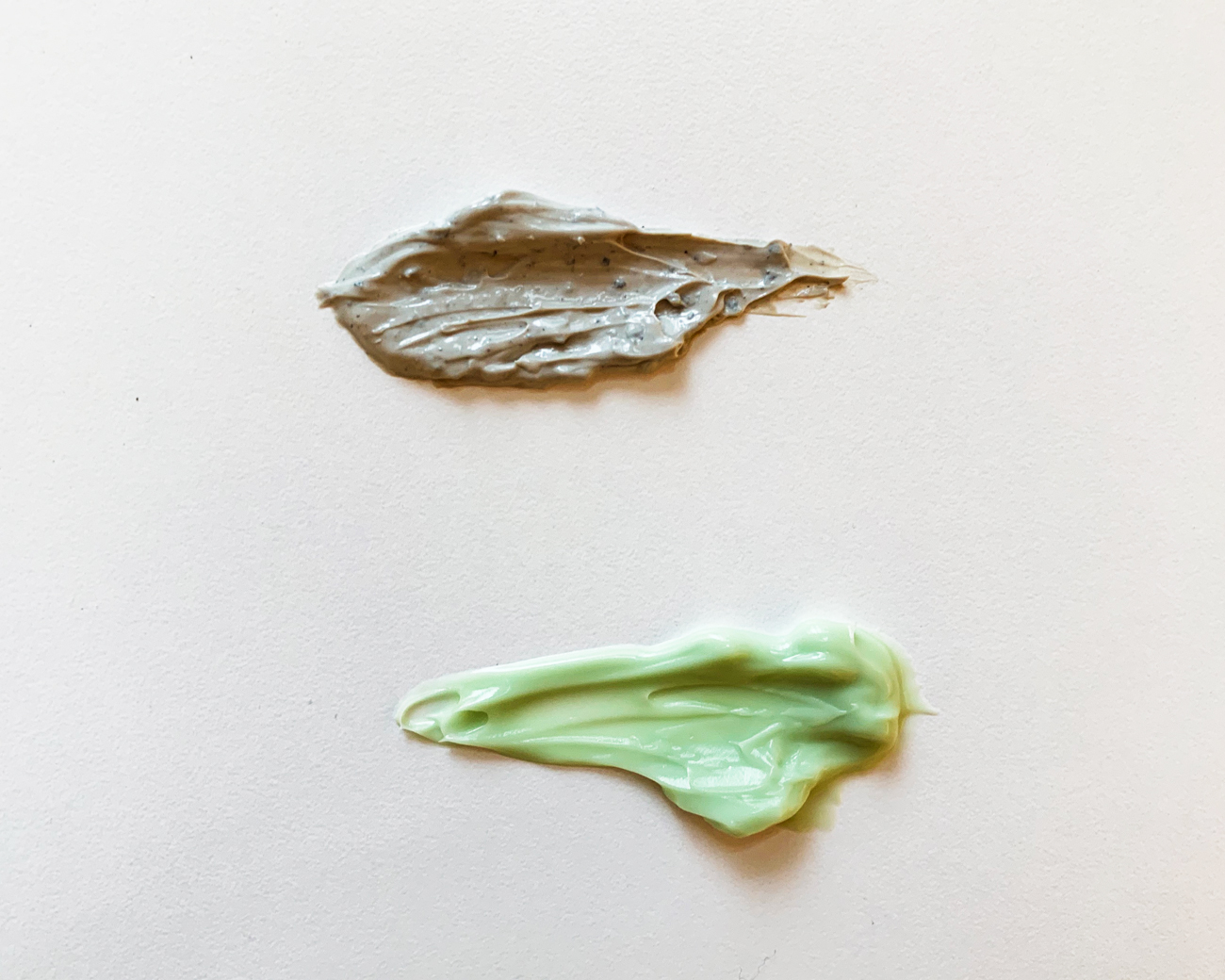
The Peach & Lily Matcha Pudding Antioxidant Cream uses matcha (obviously). It’s where it gets its natural green color, and the presence of matcha means the cream is full of antioxidants, which come from flavanoids, a type of polyphenol. Flavanoids are particularly known to have strong anti-inflammatory effects, helping reduce redness and fight acne, which can be caused by inflammation. Further, matcha actually also helps with sebum production, helping reduce the presence of oil on skin and slow the production of excess sebum.
You want your skin to have a chance to absorb all the goodness of the ingredients, so you might want a moisturizer that harnesses the extra power of matcha. The Matcha Pudding Antioxidant Cream boosts the antioxidative goodness of matcha with other beautiful ingredients, like cape lilac extract, niacinamide, and adenosine, so your skin can thrive.
Then there’s the Femmue Gentle Green Relief Mask, a kaolin clay mask that includes actual green tea leaves to help provide gentle exfoliation while also helping manage excess sebum. Ultimately, you’re going to wash the clay mask off, and you want the kaolin clay to be pulling out all the excess oil, bacteria, and gunk that might be trapped in your pores. That means you’re not necessarily going to need the intense concentration of matcha in a clay mask — green tea leaves will still provide all the amazing properties of green tea, helping fight off free radical damage, reduce redness and inflammation, and manage sebum. The leaves themselves will also bring the added benefit of gentle exfoliation when you’re rinsing the mask off.
Green tea can also be found in the essences of sheet masks! When it comes to sheet masks, you need something that will soak into skin, which means green tea extract might be the likely choice. Ariul’s Green Tea 7 Days Mask is soaked in a formula that highlights the balancing and gently exfoliating properties of green tea, without the added texture of tea leaves or matcha powder.
Should you be wary of matcha if you have sensitive skin?
There are so many great things about matcha, and one of them is that matcha is generally suitable for all skin types, including sensitive skin. Of course, though, everyone’s skin is different, so you never know how your skin will react to any given ingredient! To be safe, we always recommend spot-testing anything new.
—
We love the versatility that comes from this one shrub, camellia sinensis. Just like matcha and green tea have different uses when it comes to drinking or consuming them, they have that same versatility in skincare, which we love — there isn’t just one way for us to reap the benefits of this superstar ingredient.
Ariel Winter is fighting back against accusations that she’s had “extensive” plastic surgery.
In fact, the 21-year-old star of Modern Family denies having ANY facial surgery at all.
But ever since she shared this selfie in 2017, fans haven’t stopped asking why she suddenly looks so different.
On a more recent Instagram post, one person commented: “How many surgeries have you had on your body and face now? Two breast reductions, that’s obvious, cheek bone and chin shaving and lip fillers. Pretty obvious, she looks so different #Truth.”
“I wasn’t going to reply but I HAVE to ask… what the f— is cheek bone and chin shaving????” Ariel fired back. “You’re also wrong about all of it by the way 🙂 one breast reduction and I lost weight but you do you boo.”
For the record, breast size isn’t part of the discussion here.
But I have to ask—are the obvious changes in her facial features REALLY just “weight loss”?
I, for one, am tired of celebrities accusing us of “shaming” for wanting to know!
If you feel the same, join me in taking a look at Ariel’s beauty transformation from 2008 until now.
Ariel in 2008
Ariel Winter at the 2008 MTV Movie Awards Style Lounge.
Alright, our first pic is of a 10-year-old Ariel (she actually has been working since the age of four!). Such a cutie, right? We can see that her natural hair colour is brown, not the black she is known for, but I don’t think this reddish tint is her own. (She told People she started dyeing her hair starting at age seven to have a better chance at winning parts!)
Ariel in 2009
Ariel Winter at the 2009 premiere of ‘Under the Sea 3D.’
Next up is Ariel, pre-braces, at 11 years old. This isn’t a natural darkening of her hair colour; since Modern Family premiered later that year, I’m guessing they wanted it darker for that role. Notice her nose and lips, of course, and how she was already tweezing her brows into a skinnier shape.
Ariel in 2010
Ariel Winter at OK! Magazine’s 2010 pre-Oscar party.
The following year, Ariel’s hair dye had faded. We can see a hint of her real colour at the roots, where it is lighter and more reddish. As for the weird ringlet hairstyle, I think we’ve all been there (at least I have!).
Ariel in 2011
Ariel Winter at Elle’s 2011 Women in TV celebration.
Just before turning 13, Ariel had braces put on her teeth, and it looks like her brows were starting to grow out. (Around 2011 is when bolder brows began trending!) Her hair is looking much better in this blowout to show off the glossy reddish brown hue.
Ariel in 2012
Ariel Winter at the 2012 Wisteria Lane Block Party.
By 2012, Ariel’s braces were off, and she started experimenting with more grown-up hairstyles and makeup. (She always did love a false lash, even here at 14!) Obviously, this is very much her original nose, but also, this is her original teeth colour. I think later on she had her smile subtly brightened.
Ariel in 2013
Ariel Winter at the 2013 premiere of ‘Batman: The Dark Knight Returns, Part 2.’
By the time she turned 15, Ariel had lost that “baby-faced” look… but I still would NOT know this was her! Although her hair is lighter here, I think the main reason is her nose, which was “big” for Hollywood standards. (Meaning, it was a perfectly fine nose in “civilian” terms!)
Ariel in 2014
Ariel Winter at Entertainment Weekly’s 2014 SAG Awards pre-party.
In 2014, Ariel adopted her signature black hair colour. I have to say, she wears it well and it didn’t really occur to me that wasn’t her own! (Brows are so important in that respect, and she always kept hers a close match.) I’ve always thought she had the most beautiful skin. And her natural lips were full, but not swollen-looking.
Ariel in 2015
Ariel Winter at the 2015 Courage in Journalism Awards.
Now, this shot of Ariel at age 17 looks a little different. She has attributed her recent facial changes to weight loss, and seeing this, I’ll buy that… partially)! It does look like she may have been heavier here, which gives her already round face an even fuller look. Her teeth are now whiter than they were in 2012, but I don’t think any other procedures were happening… yet!
Ariel in 2016
Ariel Winter at the 2016 Vanity Fair, L’Oréal Paris and Hailee Steinfeld DJ Night.
A year later, Ariel looked radically different, and I’m not just talking about the jet-black wavy hairstyle and dramatic eye makeup. It could be weight loss, yes, or the fact that her hair is covering the sides of her face (making it look slimmer). Or did she have something done? I don’t think she touched her nose yet, though, and as for her lips, it’s hard to say if it’s just the lip colour. Fortunately, we can settle the debate with the next pic… are you ready?
Ariel in 2017
Ariel Winter at the 2017 New York premiere of ‘Dog Years.’
Well, well, well! I know what you’re thinking and I AGREE. Ariel (who was 19 at this point) debuted what looks like a new nose, new lips, and a more oval face shape. I mean, the lip fillers are especially obvious—the obliteration of the Cupid’s bow is such a “tell.” Between the procedures and the styling, she looks like the brunette replica of Dove Cameron!
Ariel in 2018
Ariel Winter at the 2018 ‘Modern Family’ FYC event.
Fast-forward to 2018, and Ariel’s lips continued to inflate. They’re actually lopsided! (Are you even surprised that her fans were speaking out? I guess we’re not supposed to “notice” these wonky things.) If you told me this was Kylie Jenner, I wouldn’t blink an eye.
Ariel Winter at the 2018 American Humane Hero Dog Awards.
This one is equally Kylie-esque. Even her eyebrows have been Kardashian-ified! I just think, when you have skin as lovely as Ariel does, it’s a crying shame to cover it up with all that heavy foundation, contour and blush! But get ready for 2019, because the next two pics are going to blow your mind…
Ariel in 2019
Ariel Winter at HBO’s 2019 Golden Globes after-party.
What a turnaround, right?! I have to say, I LOVE this. I’m not sure I would have recognized her, mind you, but she looks so, so good. The lip fillers have mostly dissolved, brows are natural, and her skin, hair and makeup are fresh and pretty. The question is… how did her face shape change so much?
Ariel Winter at the 2019 Entertainment Weekly and People New York Upfronts Party.
And now I definitely would not recognize her! Ariel JUST went red, with what appear to be long extensions, and she could be Isla Fisher’s little sister. (Even her brows are red, by the way!) I’m not sure how I feel about this change! Her nose, and face, are looking more petite than ever.
Ariel Winter Before and After
Ariel Winter in 2008 (left) and in 2017 (right).
Ariel Winter in 2015 (left) and in 2019 (right).
“I didn’t get plastic surgery,” Ariel has stated on her Instagram account. Do you believe her?
Looking at her nose in these side-by-side comparisons, I’m having a hard time!
To me, it does appear that she underwent a rhinoplasty… like every other person on American TV! But maybe she thinks it doesn’t “count” because all celebs do it, and it happened earlier on in her career?
Technically, lip fillers are not surgery, so she’s not lying there. But it’s super obvious that she experimented with them for a while, although it doesn’t seem like she’s using them anymore.
Then there’s the matter of her new oval face shape and tighter jawline. I have to agree that the idea of her having “cheek bone and chin shaving” is pretty radical and far-fetched.
Instead, I suspect that in addition to weight loss, she may have had Botox injected into her masseter muscles, which can have a dramatically slimming effect. (Another possibility is submental liposuction, which contours the jawline by removing excess fat.) Again, technically not surgery.
Either way, she doesn’t want us to talk about these things because it’s “not supportive of women,” as she wrote in another Instagram comment.
I say, if we really want to support women, we need to recognize how celebrities like Ariel help perpetuate unrealistic standards of “perfection,” which have been shown to have a negative psychological effect. (That’s what this column is all about!)
Of course it’s her choice to have whatever procedures she wants, and she doesn’t have to tell us anything. But there’s something particularly disingenuous to brush it off as just “weight loss,” don’t you think?
How do you feel about Ariel’s beauty evolution? Which of these looks is your favourite? What “beauty work” do you think she’s had done?
Remember when the mere thought of putting oil on your skin had you running in the opposite direction?
I still feel like that with coconut oil. I love it as a deep conditioning treatment. It makes my hair so incredibly soft and strong. It works wonders to heal chapped lips, too.
But it’s SO comedogenic, I don’t have the guts to put it on my skin. That’s why I’ve left Dr Jackson’s Coconut Melt languish in a drawer for months (I don’t even remember how I got it – probably a gift with purchase).
I found it again when I was packing for my move. It was the perfect time to try it. If I didn’t like it, I’d simply give it to a friend instead than bringing it with me to a new place.
But I didn’t go all the way… Here’s what I mean:
Coconut Oil
Dr Jackson’s Coconut Melt is 100% organic coconut oil. This oil is high in saturated fats, like lauric, myristic and palmitic. These fats make sure coconut oil oxidizes (i.e. goes bad) slowly.
It’s these fatty acids that make coconut oil so incredibly moisturizing.Studies show it’s as good as mineral oil at moisturizing skin. It’s also very gentle so babies can use it too.
Coconut oil is also the best oil for hair. It’s one of the very few oils that can penetrate inside the hair shaft, strengthening and nourishing your hair from within. It makes it stronger, shinier, and prevents breakage.
The catch? Coconut oil is comedogenic and can give you pimples. This is more of a problem with oily, acne-prone skin. If yours is dry, you can get away with slathering it all over your skin without getting a single zit.
Here’s how Dr Jackson’s say you can use Coconut Melt:
Smooth onto face to minimise the appearance of fine lines or highlight cheekbones
Condition hair: rub a small amount into ends as needed, or use as an intensive hair treatment before bed, then rinse out the following morning
Spot-treat dry areas, such as lips and cuticles
Can be used to remove eye make-up, followed on with Dr Jackson’s 07 Face Wash
Let’s Put It To The Test Personal Use & Opinion
When I first got Dr Jackson’s Coconut Melt, it had a white, solid texture. When I found it again last month, the oil had liquefied. Totally normal with coconut oil. If it’s too hot, it melts.
But hey, it still works and that’s what matters. I spent the new few days trying it out in as many ways as possible:
Lip balm: Now that I have braces, my lips can get really dry and sore. Just a layer of this and they become super soft and smooth – for hours. I honestly don’t have to reapply more than twice a day.
Eye makeup remover: It does a wonderful job at removing all traces of makeup, including waterproof mascara, quickly. It leaves a greasy residue behind, so I have to follow up with another cleanser. If you wear A LOT of makeup, it’s worth the hassle.
Conditioner: I LOVE it as a deep conditioning treatment. I leave it on my hair for a couple of hours before washing it off. It makes my hair so soft, silky smooth and so easy to manage. My hair doesn’t tangle or break as much afterwards.
Highlighter: Not a fan of this. It’s way too shiny as a highlighter.
Face Moisturizer: Remember when I told you I didn’t go all the way? I didn’t have the guts to use it on my face. But it’s a great moisturiser for my dry legs. It keeps them soft and smooth for hours.
I can’t say that Dr Jackson’s Coconut Melt made me breakout – but that’s because I chickened out and didn’t try it on the oilier areas of my face.
If you’re into natural skincare and want a multitasking product that can do a bit of everything, Dr Jackson’s Coconut Melt fits the bill. But unless you have dry skin, don’t use it all over your face!
Get access to the “Pro Skincare Library” for exclusive skincare routine “cheat sheets” and tricks to help you navigate the beauty aisles jungle like a pro and immediately know what to pick off the shelves to achieve the gorgeous skin of your dreams – even when you’re drowning in an endless sea of skincare products.
Success! Now check your email to confirm your subscription and get access to the skin library.
Have you heard of EX1 Cosmetics? Probably not; it is one of those brands that seems to only line the make-up bags of those in the know. A real shame, as truly this is a beauty company that focuses more on formulations and pigment, in a world currently dominated by pretty packaging, it is a breath of fresh air. There are several products within the EX1 Cosmetics range that I rate highly but none more so than the EX1 Cosmetics Blusher collection – small but perfectly formed none the less.
Some people can’t leave home without mascara, others bronzer and all this is in-between but for me, my face never truly looks like mine until I inject a little colour onto the apples of my cheeks. As far as blush formulations are concerned, I love them all and do have a place for most within my beauty routine, however for sheer easy of application (and prolonged wear time – hello oily skin), I do tend to favour powder products.
I’d love to tell you that all powder blushes are equal but that is simply not true, when it comes to declaring my love for a blush (regardless of texture – we don’t discriminate around these parts), I have a fairly strict list of requirements: it has to be pigmented but not so much that it is overwhelming and difficult to blend, it has to wear well in all conditions (hot, cold, humid etc) and it has to be reasonably priced (sadly my lottery numbers have yet to come up) and perhaps a given, but I have to like the shade both in the pan and on my skin. Many a blush has stumbled at the first hurdle but not the EX1 Cosmetics Blusher collection.
Sadly at the moment the EX1 Cosmetics Blusher collection only offers four shades: Jet Set Glow (pink nude not too dissimilar to Benefit Dallas), Love Story (a reddened deep brown), Natural Flush ( muted coral pink – not worlds apart from NARS Orgasm but minus the shimmer) and Pretty in Peach (a true bright peach). Admittedly some of the shades are a tad too deep for my complexion but as they are so natural in tone, I can utilise them as eyeshadows (Love Story) or even a bronzer (Jet Set Glow) should I wish.
As great as the shades are, the real reason I recommend the EX1 Cosmetics Blusher collection is due to the formulation: soft, easy to blend and yet it doesn’t produce a lot of product fall out, long-wearing and yet not prone to clinging to dry skin or enlarged pores, matte yet not flat, and for those of us with easily irritated skin, the fact that it is fragrance and oil free is nothing short of glorious.
I truly am pushed to as much as recall a matte blush that can come close to the EX1 Cosmetics Blusher formulation, let alone rival it price.
You can find all four shades via FeelUnique – link.
Those are just in product names. When you look at ingredient lists, you see them even more. Ground Plan’s Cell Power Energy Essence is a waterless essence that has an oatmeal extract base. The Peach & Lily Lazy Day All-in-One Moisture Pads contains extracts from various fruits and vegetables — carrots, broccoli, pomegranate, to name a few. The Laneige Lip Sleeping Mask has multiple berry extracts, including strawberries, blueberries, and raspberries.
These are all foods we eat, foods that are known to be good for us, and they pop up in skincare all the time. That made us wonder — is it enough for our skin if we just eat foods that are rich in antioxidants and vitamins and nutrients? Or is it better to apply them topically via skincare products? Are some of these ingredients, like berry extracts, just included to make products smell good? We decided to find out.
I eat healthy! Isn’t that enough for skin?
Without getting too science-y, eating versus topically applying ingredients means they reach skin differently.
When you eat something, that food product is digested, broken down, and distributed throughout your body. Your vital organs take priority, so your body can function properly, and skin, despite being the largest organ of the body, is kind of low on the list of priorities. It makes sense when you think about it — you want your brain, lungs, heart, kidneys, liver, etcetera to get everything they need, so you can function and flourish overall. Non-vital organs can come later.
However! That doesn’t mean that skin doesn’t see any effects from you eating well; when you’re healthy and feeding your body properly, your skin has a better chance of also being healthy. The body, after all, is still one unit, and, if one part of it is impacted, whether positively or negatively, that can affect the body as a whole.
It’s like water — you probably know that you should be drinking water regularly throughout the day. People like to say that you should drink a lot of water for healthy, hydrated skin, and that’s true, just not in the ways people might be thinking. The water you drink doesn’t necessarily make it to your skin but goes mainly to your vital organs and picks up waste and toxins, which you’ll dispel as waste as it passes through your body. However, if you’re drinking enough water, you can still see and feel the effects on your skin — it might feel healthier and look clearer, not because the water you drink is going directly to your skin but because your body, overall, is reaping the benefits of being sufficiently hydrated.
As it turns out, food works similarly in a systemic way.
So is applying topically better?
If consuming ingredients works systemically, impacting your body as a whole, topically applying ingredients works only on the areas you target. That makes logical sense — when you apply skincare to your face, you don’t expect to see effects on your knees.
The advantage to topical application is that it delivers higher concentrations of ingredients to skin, which can show more drastic results on skin than consuming those same ingredients might. Because they don’t have to pass through the digestive tract, these ingredients can have a more direct impact on skin, directly addressing specific skin concerns, from breakouts to dullness to visible signs of aging, etcetera.
So which is better?
Honestly? It’s important to do both! Studies even show that the best results come from eating these great ingredients and topically applying them. It’s a more holistic approach that acknowledges the systemic benefits of eating foods that are rich in antioxidants, vitamins, and nutrients while also recognizing the benefits of directly targeting skin and addressing specific skin concerns with topical application — and we tend to agree! Skin, after all, is an organ and should be supported from the inside-out!
—
We hope that helped! Tomorrow, we’ll go into a few of our favorite ingredients that we can eat (or drink!) and apply topically!
What are the best products for fine lines and wrinkles? Like, what really works?
It’s a minefield out there. From retinol to peptides and papaya enzymes, everything promises to rid you of those wrinkles and turn the clock back 10 years.
How do you make sense of it all and chose products that can get the job done – for real? Fret not, I’ve got your back.
Here are the best skincare products for fine lines and wrinkles (and why they make the cut):
Best For Reducing Wrinkles: Drunk Elephant A-Passioni Retinol Cream ($74.00)
In OTC serums, you’re more likely to find retinol. It’s a gentler form of Vitamin A that fights wrinkles in three ways: it destroys free radicals before they can give you wrinkles, boosts collagen production to firm skin, and speeds up cellular turnover (ie. the skin’s natural exfoliating process) to smooth out wrinkles.
Retinol works – slowly. It takes up to 2 months for it to start boosting collagen production. Needless to say, the higher the concentration, the better the results you get.
Drunk Elephant A-Passioni Retinol Cream contains a whopping 1% retinol. I know 1% doesn’t sound like much, but for retinol it’s huge. So huge, if you start with it straight away, you’ll turn your skin into a flaky red mess.
The trick is to start with the smallest concentration of retinol you can find (even 0.01% works!) a couple of nights a week and build up both dose and frequency gradually until your skin can tolerate A-Passioni.
It’s totally worth it. Retinol aside, this anti-aging cream is loaded with natural oils and niacinamide to moisturise skin and strengthen its protective barrier, and antioxidants to keep new wrinkles at bay.
Best For Wrinkle Prevention #1: Skinceuticals CE Ferulic ($166.00)
Skinceuticals CE Ferulic is one of the very few products I’m willing to sell a kidney for. It was the first serum to feature one of the most powerful antioxidant combinations out there: Vitamin C + Vitamin E + Ferulic Acid.
Best For Wrinkle Prevention #2: Niod Survival 30 (£25.00)
I can’t stress this enough: NOTHING in this list will work if you skip sunscreen. UV rays are to blame for up to 90% of premature aging. You’re sabotaging your routine if you don’t slather sunscreen on every morning.
The catch? It’s thick, hard to spread and leaves a white cast behind. I don’t know how Deciem did it, but their Niod Survival 30 avoids all this crap.
The tinted texture is so lightweight, it dries out quickly without making you look like Caspar The Ghost. It’s comfortable to wear and works well under makeup.
Best For Firming Skin: Niod Copper Amino Isolate Serum 2:1 (£38.00)
I’m VERY sceptical when it comes to peptides. They promise to firm skin, reduce wrinkles and do all kinds of cool things for your skin. Problem is, most of the studies supporting their effectiveness come from the manufacturer. Take them with a pinch of salt!
But there’s a growing body of evidence showing that copper peptides at least may be the real deal. Copper-Tripeptide-1, for example:
Let’s be clear: if you’re still young, copper peptides won’t do much for you. Your skin is still functioning as it should and producing most of the collagen it needs.
Once you reach the big 4-0, adding copper peptides to your skincare routine makes sense. The most effective copper peptide serum I’ve found so far is Niod Copper Amino Isolate Serum 2:1.
Best For Sensitive Skin: Paula’s Choice 10% Niacinamide Booster ($44.00)
I believe everyone should use niacinamide. But if your skin’s so sensitive, it can’t tolerate harsher antiaging superstars like retinol and vitamin C, it’s an absolute must.
This form of Vitamin B3 is gentle, work well with every other ingredient (yes,
I like to get my fix from Paula’s Choice 10% Niacinamide Booster because it’s loaded with antioxidants that help you prevent new wrinkles from forming. Plus, you can use it alone or mix it with your fave serums and moisturisers.
What do you think are the best skincare products for wrinkles and fine lines? Share your fave picks in the comments below.
Take The Guesswork Out Of Skincare Shopping
Get access to the “Pro Skincare Library” for exclusive skincare routine “cheat sheets” and tricks to help you navigate the beauty aisles jungle like a pro and immediately know what to pick off the shelves to achieve the gorgeous skin of your dreams – even when you’re drowning in an endless sea of skincare products.
Success! Now check your email to confirm your subscription and get access to the skin library.




 Dawn Siler