There are very few products that can rival the popularity of Charlotte Tilbury Pillow Talk Lip Cheat Pencil, the hype that one lip liner generated is frankly unrivalled and I can see why. A creamy formula in the a hue of the most perfect nude-pink, allowed it to instantly rocket to best-seller and then cult-like status. A shade so iconic, that not only did it spawn waiting lists and fans worldwide but a matching lipstick shade and then a cosmetic range to boot. Your (other) favourite lip liner could never.
What’s next? A sleepy yet sensual fragrance or maybe more sultry lip shades in a range of finishes, who knows? Until then let me share the two latest additions to the Charlotte Tilbury Pillowtalk range and tell you why one has surpassed my love for the original lip pencil.
As soon as the news broke that Charlotte Tilbury was to indeed launch Pillowtalk in lipstick form, I immediately ordered two sticks there and then. Just when I thought the world of dusky pink nudes could get no better, along comes not only the Charlotte Tilbury Pillowtalk Luxury Eyeshadow Palette but also the Cheek to Chic Blush in Pillowtalk – talk about a make-up lovers dream coming true.
Swatches above – left to right: deeper outer shade, light centre shade and the two shades combined.
Now admittedly as much as I do harp on about the virtues of Charlotte Tilbury Pillowtalk in all its various guises, I do have to be entirely objective and state that the Cheek to Chic Blush just doesn’t do it for me. The warm, almost ruddy tone of the main powder, coupled with the pale, frosty centre that can emphasis enlarged pores et al, translates to a muddy, almost dirty streak of colour on my pale complexion. However I do think that this is a case of you can’t win them all and on medium to deeper skin tones, this would be nothing but beautiful. All is not lost though, I do enjoy wearing the lighter colour of two as a highlighter (I target it with a small brush) and on occasion have been known to wear both segments as eyeshadow.
Speaking of eyeshadow if you enjoy slightly warmer nude toned hues then I do consider the Charlotte Tilbury Pillowtalk Luxury Eyeshadow Palette to be an absolute essential. Yes I went there but with four easy to blend, apply and wear eyeshadows all of which have been created to enhance all eye shapes and colours – it is easy to see why it has quickly become a firm favourite of mine and of so many others too. What I personally enjoy about all Charlotte Tilbury eyeshadow quads is that they are beyond user friendly; on the back of each compact you will find each shadow numbered with a brief description of how and wear to apply, making expert application a complete breeze. Again to be completely unbiased, I do find that the "pop" or more commonly referred to glitter shade doesn’t have the best colour pay-out and as such is best layered over other eye products to really make the most of the formula.
In a nutshell if you are already a fan of the Charlotte Tilbury Pillowtalk lip products, you are going to want to add both of the powder products to your stash – it’s a non-brainer.
Charlotte Tilbury Pillowtalk Luxury Eyeshadow Palette £39 – link.
Charlotte Tilbury Pillowtalk Cheek to Chic Blush £30 – link.
Don’t you ever wish you could look Facetuned in real life?
Get yourself a bottle of Niod Photography Fluid Opacity 12%. It’s like having a makeup artist, digital photographer and Photoshop all rolled into a bottle.
I know, it sounds insane. I picked this baby up on a whim, thinking it’d be just a fun gimmick to try and OMG, I can’t live without it now.
I already have good skin, but this brings it to a whole new level. Did I mention it’s INSANE?! Here’s what I mean:
Key Ingredients In Niod Photography Fluid Opacity 12%
Silicones To Blur Out Imperfections
Hear me out, please. I know silicones have a bad rep, but there’s a reason you’ll find them in every makeup primer. They blur imperfections like nothing else.
It works like this: silicones create a protective barrier on the skin. When the light hits its, they reflect it, giving off a natural glow that blurs out any imperfections in the area.
Your large pores, fine lines and any other imperfection is still there. But other people won’t notice them anymore. If not invisible, they’ll look much smaller.
Trimethylsiloxysilicate: a silicone resin that creates a non-tacky film over the skin to help makeup last longer.
Hexamethyldisiloxane: a thin and volatile silicone that helps formula spread easily onto the skin before it evaporates into thin air.
Cyclopentasiloxane: a thin and volatile silicone that makes skin so soft and smooth.
Dimethicone: it fills in fine lines and wrinkles and makes skin silky soft.
But wait, don’t silicones suffocate skin? Nope. Silicones have a particular molecular structure made up of wide molecules with big gaps in between. Your skin can still perspire though these gaps.
Silicones aren’t the only ones that can pull off a trick or two with lights.
Niod Photography Fluid Opacity 12% also uses a Nano-Prismatic Blurring Suspension to mask imperfections. That’s a fancy way to call mica and titanium dioxide.
I’m sure you know titanium dioxide. It’s a common UV filter. Mica is a common mineral powder. Here, they do the same job: they reflect light away from dark spots, wrinkles, large pores and co, so it looks like they aren’t there.
On it owns, it’s hard to apply. It doesn’t spread easily on the skin and tends to cake a little. If you’ve got any dry patches, this’ll make them look 10x worse.
But OMG, it makes my skin looks amazing. It’s like a highlighter for the face that makes you look radiant. Every time the lights hits my face, I positively glow. My pores look invisible. My fines lines, almost. You can’t really notice them that much anymore.
If you’ve got any sallowness or redness, Niod Photography Fluid Opacity 12% will hide those too. But if you’ve got some serious imperfections to hide, like a sprinkle of dark spots on your chin, you need to mix it with your foundation.
Heck, even mixing Niod Photography Fluid Opacity 12% with a tinted moisturizer turns up the coverage a notch or two. Seriously, it’s like wearing a Facetune filter that makes you look flawless from every angle.
Mixing it with foundation or primer makes it much smoother to apply. It glides on easily and doesn’t look cakey here and there anymore. It’s magic in a bottle, I tell you.
The only thing I don’t like? The packaging. The fluid is a little too thick for the dropper bottle and tends to accumulate (and dry out) at the edges. But hey, it’s a small price to pay to look flawless, right?
P.S. Niod hasn’t forgotten about darker skin tone. The 8% version has a darker hue that’s perfect for you. 🙂
Get access to the “Pro Skincare Library” for exclusive skincare routine “cheat sheets” and tricks to help you navigate the beauty aisles jungle like a pro and immediately know what to pick off the shelves to achieve the gorgeous skin of your dreams – even when you’re drowning in an endless sea of skincare products.
Success! Now check your email to confirm your subscription and get access to the skin library.
“OMG, is that a wrinkle?! Aren’t those supposed to appear when you’re like, 60?”
I was 25. I had spent most of my summers till then frolicking under the sweltering Italian sun – sans sunscreen. That was something you only wore at the beach and I HATE the beach. I didn’t need that stuff.
Until one day I looked in the mirror and I saw a HUGE (ok, it wasn’t huge, but it looked like that to me) crow’s feet in the corner of my eye. How did this happen?! You’re not supposed to get wrinkles at this age!
Or… are you? I mean, in the age of Photoshop and Kardashian facelifts, do we even remember what a human being looks like anymore? At what age is it normal to get your first wrinkles and how can you tell if your skin is aging faster than it should?
Let’s find out:
At What Age Is It Normal To Get Your First Wrinkle?
When you’re young, naive and your skin bounces back straight after a stretch, it’s easy to think wrinkles are something that happens only to old people.
Truth is, wrinkles WILL get you much faster than that. It’s TOTALLY NORMAL to notice your first wrinkles in your late ’20s, especially on your forehead, between your eyebrows or around your eyes.
WTH? Why so soon?
The main culprit is unprotected sun exposure. If you’re anything like me, you didn’t have parents who slathered you in sunscreen from the moment you were born. For most of us as kids, sunscreen was something we only used at the beach, not when playing in the backyard in the heat of summer.
Sure, if it were a particularly boiling day, your mum would force sunscreen on you to avoid sunburns. But no one knew back then that sunscreen helps prevent wrinkles, too. All that sun damage you got as a kid is already starting to show up in your late ’20s.
The other culprit? Repeated facial movements, like smiling, frowning or squinting overtime leave fine lines etched all over your face. But, I’ll take those. I mean, can you imagine a life without smiling?
From your late 20’s onwards, your wrinkles will slowly become longer and deeper. You’ll get new wrinkles, too. It’s after menopause, and the sudden loss of collagen that brings, that wrinkles start getting really deep.
P.S. People with darker skin tones (and more melanin) usually develop wrinkles more slowly and at a later age.
3 Signs Your Skin Is Aging Faster Than You Should (And What To Do About Them)
Truth bomb: when it comes to premature aging, your lifestyle matters more than your genes.
Those wrinkles you were blaming on your parents? A bad diet’s more likely to be the culprit. So, how can you tell if you’re doing something to speed up the aging process?
Here are 3 signs your skin is aging faster than it should (and what to do about them):
1. You’re getting fine lines/wrinkles in your EARLY ’20s or DEEP wrinkles by your early ’30s
It’s ok to get fines line around your eyes, mouth and forehead in your late ’20s. But if they appear before that or they already look like deep craters by your early ’30s, your skin is losing collage faster than it should.
Collagen is the protein that keeps your skin firm. After you turn 21, your skin loses 1% of collagen every year until you reach menopause. But the wrong lifestyle habits can speed up the process and destroy collagen faster, making your skin sag and wrinkle before its time.
Here are the biggest culprits:
Lack of sleep
Pollution
Repeated facial movements
Smoking
Stress
Unbalanced diet rich in processed foods and low in vegetables
Unprotected sun exposure
How To Fix It
Your lifestyle has the biggest impact here. You can use the best skincare products in the world, but if you don’t slow down the overproduction of collagen-destroying free radicals, you’re fighting a losing battle.
Here are a few good lifestyle habits to pick up for younger-looking skin:
Eat the rainbow: fruits and vegetables are rich in antioxidants that fight the free radicals that give you wrinkles. Eat your 5 portions a day. The more, the better.
Get 8 hours of sleep every day: turn down all your devices (yes, even your phone) at least 2 hours before you go to sleep.
Meditate: any form of mindfulness (meditation, yoga, walking in the park) reduces stress, one of the main causes of inflammation and free radical production.
Quit smoking: few things generate more free radicals than smoking. The sooner you quit, the better for your skin (and health).
Use skincare products with retinol: retinol fights free radicals, boosts collagen production and speeds up your skin’s exfoliating process, helping wrinkles fade away faster.
Wear sunscreen: every single day, come rain or come shine.
P.S. Don’t try to change everything at once. Pick one habit at a time. And give yourself permission to fail. It’s normal to fall off the bandwagon or have a cheat day when you’re trying to pick up a new habit. Give yourself a big hug and try again the next day.
You can get freckles or melasma at any age. But getting SUN spots in your ’20s means you’ve got too much unprotected sun exposure and it’s making you age 2x faster.
Once UV rays hit your skin, they destroy everything in their tracks. Collagen. Elastin. Cellular DNA. At first, the damage is so small, you barely notice it. But overtime, it gets so bad, it shows up in the form of wrinkles and dark spots.
The worst part? These nasty buggers can penetrate through clouds and windows and even be reflected on snow. Don’t think you’re safe because you’re indoor or it’s raining. They can still get you!
How To Fix It
Two ways:
Wear sunscreen: every single day, come rain or come shine. Reapply as often as needed. You can use the best skin-lightening creams in the world, but dark spots will keep coming back if you keep exposing your skin to the sun.
Use a skin-lightening cream: hydroquinone is the most powerful, but in most country it’s available only by prescription. Arbutin, azelaic acid and kojic acid are all good alternatives. They inhibit the production of melanin, so your dark spots can slowly fade away.
Hydrated skin = younger-looking skin. Moisture plumps up fine lines and wrinkles, makes skin softer to the touch and gives your skin a natural glow.
But when skin starts losing moisture, everything goes south. Your skin dries out and shrivels to an old prune. The wrinkles you already have look 10x worse. Overnight.
How does this happen? You lose moisture when your protective barrier is damaged. Moisture evaporates through the cracks, leaving your skin dry and flaky.
How To Fix It
Fixing dryness is a two-step process:
Strengthen your skin’s protective barrier: rich moisturizers with niacinamide, ceramides and natural oils patch up the holes in your protective barrier, so that moisture can’t escape.
Use a hyaluronic acid serum: hyaluronic acid holds up to 1000 times its weight in water. It’s the quickest way to give your skin the hydration boost it badly needs. Just make sure to follow up with moisturiser. No point adding moisture back in if it evaporates through the cracks!
Best Skincare Products To Strengthen Your Skin’s Protective Barrier:
Need more help to keep those pesky wrinkles off your face? Click on the image below to subscribe to my newsletter and receive my free ebook “5 Best Anti-Aging Tips To Keep Skin Young”:
✕
Best Anti-Aging Tips!
Sign up to receive my short ebook, “5 Best Anti-Aging Tips To Keep Your Skin Young”.
Success! Now check your email to confirm your subscription and receive the “5 Best Anti-Aging Tips To Keep Your Skin Young”
Is your skin aging faster than it should? Let me know in the comments below.
Take The Guesswork Out Of Skincare Shopping
Get access to the “Pro Skincare Library” for exclusive skincare routine “cheat sheets” and tricks to help you navigate the beauty aisles jungle like a pro and immediately know what to pick off the shelves to achieve the gorgeous skin of your dreams – even when you’re drowning in an endless sea of skincare products.
Success! Now check your email to confirm your subscription and get access to the skin library.
Welcome to our Hair Consultations column. To request an online hair consultation, follow the instructions here.
Q: I am 61 years old and my hair is curly, wavy, coarse and frizzy. I live in humid Florida, and I don’t think the cut I have now is good for controlling the frizz.
Denise wants a haircut that will help control her frizz.
I have never used any chemicals, dyes, rinses, perms, etc. and I don’t put heat on my hair. I use Silk18 Conditioner, DevaCurl Frizz-Free Volumizing Foam and Redken Curvaceous Curl Refiner. After washing (about twice a week), I make two braids, Indian style, and let it air-dry. My hair will look great for two or three hours and then begin to poof up and frizz.
I would like it to lay flatter against the side of my face for a longer period of time. Any suggestions on style and/or product to achieve that result? Thank you for considering my questions. — Denise
Denise would like her hair to lie flatter on the sides of her face.
A: Denise, thank you for your pictures and question.
The bangs suit you—they’re beautiful. For you, the most important thing is that your hair should be de-bulked. This will help your curls to be more defined and full of motion.
Your hair needs to be texturized around the jawline with regular scissors (not thinning scissors), going in and slicing out some of the weight. When you do that, it goes from being bulky to allowing freedom between the curls. So the curls will relax and move better, instead of clumping on top of each other with no room for them to move.
That’s why your hair is looking like a triangle shape—because whoever is cutting it is not using this particular technique. The layers are dropping too far below your cheekbones and weighing everything down.
Jessica Biel at the 2006 Hollywood Life Breakthrough of the Year Awards.
Your cut should be about half an inch shorter, and the widest point should be at the bottom of your neck, just above your collarbone.
For styling, the right products are key, especially if you are air-drying and living in Florida.
Kérastase Elixir Ultime Oil Serum
Kérastase Elixir Ultime Oil Serum is a liquid silicone. This guy will coat your hair to de-frizz the curls. It will make it heavier and shinier. Use this first, about a teaspoon, on towel-dried wet hair. Your hair’s going to suck it right up.
Then apply about twice as much of the AG Hair Curl Re:Coil Curl Activator. Some curls will be curlier than others, so this will help balance the curls all over your head.
AG Hair Curl Re:Coil Curl Activator
Then you have to lean to one side and scrunch, and then lean to the other side and scrunch. Then, put your hair in place. Once it is in place, you let it air-dry.
I would stop doing the braids. I know you are trying to get more curl out of it, but the braids are confusing your hair. Not braiding will actually balance your curls better.
Here are some photos of how defined your curls could look with the right cut and products.
AnnaLynne McCord at the 2009 premiere of ‘The Taking of Pelham 123.’
AnnaLynne McCord at the 2008 CBS/CW/Showtime TCA Party.
Tony Chaar is one of Canada’s top celebrity hairstylists and the owner of Tony Chaar Salon at 140 Avenue Road in Toronto. Call 416-920-9965 to book an appointment.
French women are famous for their flawless, foundation-free skin—and perhaps the reason why is this cult-favourite retinol.
A313 Vitamin A Pommade is a pharmaceutical-grade vitamin A sold over-the-counter in France, and if you ask me, it’s one of the country’s BEST beauty secrets.
But you don’t need a flight to Paris in order to buy it (although that would be nice!). I recently stumbled across it on Amazon, and now it’s been part of my skincare routine for about three months. Spoiler: It has quickly become my favourite retinol!
If you’re keen to try an inexpensive yet potent retinol, read on!
A313, the New Avibon
A313 Vitamin A Pommade is the new version of Avibon.
First, a little background for you. Before A313 Pommade, there was another French retinol called Avibon.
Like most people, I learned about it from an old Goop newsletter. According to Gwyneth Paltrow:
“Avibon is hard to find outside of France, but it’s one of my very favourites. It’s full of Vitamin A, which is wonderful for the skin, getting rid of blemishes, tough dry spots and preventing wrinkles (they say). I know an older movie star who uses this every night and she has the most amazing skin!”
When she wrote that back in 2012, Avibon instantly achieved cult status. Even so, it remained out of reach for most people, since you had to actually GO to France in order to buy it.
Alas, I didn’t manage to make it there before Avibon was suddenly discontinued in 2013. An blurb in OTC bulletinexplains why:
Sanofi has stopped marketing its Avibon vitamin A skin ointment in France. After batches of the ointment were recalled in March 2013 due to “product stability” problems, Sanofi’s “various attempts at improvement” had not resulted in “a product that met current quality standards,” a spokesperson for the French firm told OTC bulletin.
Fortunately for us, they quietly introduced a replacement product, A313, that same year. And now, thanks to the Internet, it’s just a click away!
A313 Ingredients
The A313 ingredients list.
So, what’s in A313, exactly? And what’s the difference between A313 and Avibon?
Let’s start with A313. The packaging is in French, of course, and states that the active ingredient is 200,000 IU of synthetic vitamin A in “oily” form. (We’ll talk texture in a minute.) Since 1 IU is equivalent to 0.3 micrograms, and each tube is 50 grams, this works out to a 0.12 percent concentration.
Unfortunately, there’s nothing on the tube or box that specifies which type of vitamin A they’re using, so I did a little more digging. According to CosDNA and INCIDecoder, it’s a combo of retinyl acetate, retinyl propionate and retinyl palmitate.
These are the mildest forms of vitamin A, called retinol esters, and they have to go through three conversion steps to become retinoic acid (the active form of vitamin A that can be used by our skin). The conversion process looks like this:
So that means the 0.12 percent vitamin A in A313 is not the same as a 0.1 percent prescription retinoid like Retin-A, which is pure retinoic acid. A313 is weaker—technically, even weaker than retinol. But the weird thing is, I actually find it stronger!
A313 is also milder than its predecessor. Avibon boasted five times the amount of vitamin A, 1,000,000 IU, in a 30 gram tube. That’s equivalent to 1 percent. But I have to say, I’m not sure I could have handled that!
As for the inactive ingredients, A313 is in a base of polyethylene glycol (“macrogol”), which is both a stabilizer and a penetration enhancer. That right there might explain why it works so well, because more of the actives are able to get into the skin. A313 is also unscented.
In contrast, Avibon had a lanolin base and was fragranced.
A313 Benefits
A313 can treat wrinkles, pigmentation and acne.
A313 doesn’t make any claims regarding what it can treat, but based on its active ingredients, here’s what you could use it for:
Fine lines and wrinkles: Both retinyl propionate and retinyl palmitate has been shown to reduce facial wrinkles, according to this 2007 study and this 2018 study. Another study, in 2010, found that retinyl propionate along with niacinamide and peptides gave comparable results to tretinoin, without the irritation. Retinyl palmitate also thickens the skin, according to this 1988 study.
Pigmentation:This 2007 study found that retinyl propionate improved hyperpigmentation. You could also use it to help fade post-acne marks.
Actinic keratosis: This 1998 study found that retinyl propionate reduced actinic keratosis lesions to zero after 48 weeks. (This is a skin condition associated with UV damage, resulting in patches of thick, scaly skin.)
Acne, oily skin, blackheads: I couldn’t find any studies proving that retinol esters can help with breakouts and excess oil production, but in my experience, they definitely can! I believe they can also reduce the appearance of large pores.
A313 Texture
A313 has a thick, ointment texture.
I’m going to warn you right now, the texture of A313 is probably unlike anything else you’ve put on your face before.
It’s a thick, translucent ointment. Kind of like Vaseline, or a pure lanolin such as Lansinoh.
A313 coats the skin with an oily film.
In fact, it is so thick that it’s a little challenging to spread around. Once you do, it leaves your skin coated with a greasy, shiny film. No, this is not a cute night treatment!
But I’ve actually come to LIKE the texture, believe it or not. It feels somehow more nourishing and protective than other retinoids.
Plus, when you wake up in the morning, your skin will be unbelievably soft, plump and hydrated. I’ve never noticed results like that from any other skincare product!
How to Use A313
The pamphlet inside the A313 box.
There’s a little pamphlet inside the A313 box, again all in French. I thought it would include usage instructions, but nope—just general warnings like:
Don’t use it if you have an allergy to one of the ingredients
Don’t use it on infected or weeping skin lesions, mucous membranes or burns
Talk to your doctor before using it if you are pregnant
Don’t store it above 25°C (77°F)
So they kind of leave you on your own with this stuff. But not to worry—after using it religiously since the end of December, I’ve got a few tips!
Here’s what I’d recommend:
Use it at night: The pamphlet actually says “one or two times a day,” so you could technically apply it in the morning (as long as you wear sunscreen!). But you’re going to look like you dipped your face in a vat of grease, so I think nighttime is best.
Make sure your skin is dry: This is really important. Your skin has to be FULLY dry in order to prevent irritation. You want to wash your face and then wait a good 20 to 30 minutes. When I didn’t do this, it made my skin feel super itchy and uncomfortable.
Avoid other actives (at first): For the first week or two of A313, I stopped using my nightly acid exfoliator beforehand, in case both were too much for my skin. But once I started to develop a tolerance, I introduced the acid back, 30 minutes before the A313. See this tutorial about how to layer an AHA or BHA and retinol in your routine.
Use a pea-sized amount: A little goes a long way, so this should be enough to do your entire face. You can also use it on your neck and chest if you like (so this might take another half pea).
Spread it in a thin layer: I dispense about a quarter of a pea at a time, applying it to my face in quadrants (left side, right side, mouth/chin and nose/forehead). You can use retinoids to treat eye-area wrinkles; just be cautious because the skin is thinner there, and more susceptible to irritation. Also be very careful that you don’t apply too much, because it could migrate into the eyes (as well as get over your pillowcase).
Moisturizer is optional:A313 is very moisturizing, so there’s a good chance you won’t need any nighttime hydrators. However, if your skin is dry or experiencing irritation, you have a few options. You could layer a light serum or night cream underneath (30 minutes before). You could mix the A313 with equal parts cream. Or you could layer a cream or oil on top (but wait another 20 or 30 minutes so the A313 has a chance to absorb). Keep in mind that all of these will dilute its effectiveness, though.
Expect itching and flaking: Although making sure your skin is dry definitely helps, you will probably notice some annoying itching after the first few applications. Try to ride it out if you can, because this eventually goes away once your skin gets used to it. Another side effect is flaky skin, but again, this should improve over time. If the dryness and irritation are too much, you can always back off for a night or two and then start up again.
Wear sunscreen: This goes without saying, but especially when using vitamin A! Check out my guide to the best face sunscreens if you need some recommendations.
Build up slowly: For best results, you want to be using your retinoid at least three times a week. If your skin is used to vitamin A (like mine), then you might try every other night, moving up to nightly applications after a couple of weeks. Otherwise, for more sensitive skin, follow the “1-2-3” rule. Use it once a week for one week, twice a week for two weeks, and then three times a week for three weeks. After that, you can keep increasing the frequency or stop there if it’s all you can tolerate.
You might purge: If you’re acne-prone and new to retinoids, you may get purging for the first month or two. This is actually a GOOD thing (see my purging vs. breakouts tutorial). Although anything is possible, I think A313 is unlikely to trigger actual breakouts. I am acne-prone and didn’t experience any!
My Results from A313
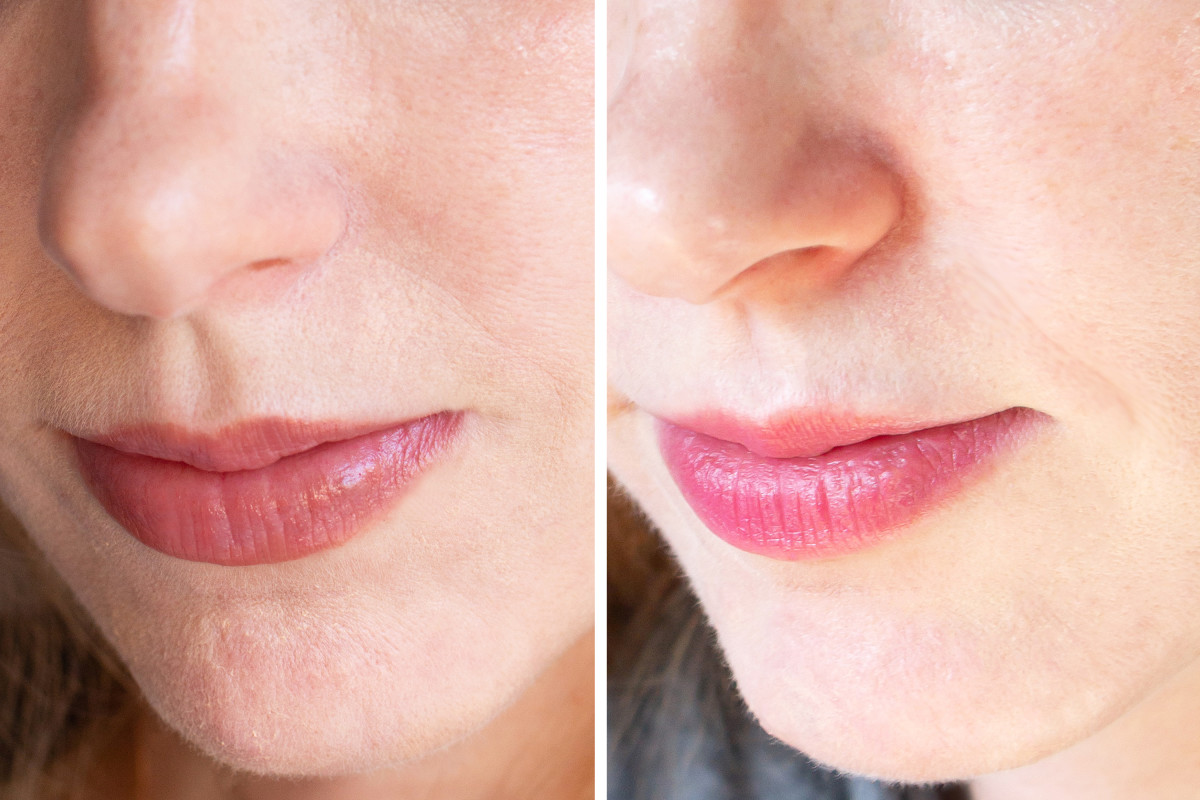
Flaky skin during my first month on A313 (left) vs. smoother skin after three months on A313 (right).
I will confess that I skipped the “building up” stage with A313 and jumped right into nightly applications. I figured I could handle it, since I’d already been using Shani Darden’s Texture Reform (reviewed here), another retinol ester-based product.
Well, I was surprised to discover that A313 is VERY strong! Not only did I experience itching for the first week or so, but my skin got really dry and really flaky. It wasn’t irritated, just peeling off around my chin and nasolabial folds, as you can see in the “before” photo on the left.
Now, three months along, the flakiness and dry skin have mostly gone away.
My skin, after using A313 for about three months.
I have much more of a glow, and my skin texture is also nice and smooth. (Smoothness was actually an immediate benefit, after the first time I used A313!)
I don’t know about wrinkles, but I think A313 has made my skin look a little firmer and plumper. Plus it seems to even out my tone (keeping in mind that I’m also a big acid user, so that helps, too).
Probably my favourite benefit of all is how A313 keeps breakouts under control. Not only does it reduce the incidence of acne, but it also speeds the healing of any existing blemishes. I’ve heard that some people use it just as a spot treatment, and you could certainly do that, but it will be more preventative if you apply it all over.
Conclusion
A313 is one of the strongest over-the-counter retinoids.
Lately, I keep seeing A313 on Instagram, and it’s always on those lists of “French pharmacie” beauty products. So the hype is definitely growing. But it’s well deserved—France really does do retinol better!
As someone who finds Retin-A too strong, but many over-the-counter retinols too weak, A313 hits that perfect sweet spot in the middle. I still don’t know how, since it only contains mild retinol esters, but I’ve test-driven enough retinoids to KNOW that it’s working. After three months, I can clearly SEE the results.
It’s also a fraction of the price of popular retinols like Retinol Reform and A-Passioni, and a tube will last you for months.
So if you’re looking for a powerful, affordable anti-aging and anti-acne treatment, this French beauty secret is for you. I love A313 so much, it is now my number one retinoid recommendation. Let me know if you try it!
Name: Sabrina Uddin Practice setting and job title: Dermatologist at The Derm Centers in Chattanooga, TN Fitzpatrick skin type: 3 Oily vs. Dry vs. Combination skin: Dry / sensitive AM Regimen: Cleanser: none/occasional La Roche Posay Micellar water on damp skin. Extras (antioxidants, medicines, etc.): Skinceuticals Phloretin CF, Banana Bright Eye cream by ole Henrikson […] Read more…
There’s more to skincare than cleansing and moisturizing.
This is even more true when you’re dealing with eczema. Lotions and potions can keep the symptoms under control, but they can’t target the root cause. Like stress or a bad diet. And they can’t make the healing process easier to deal with.
That’s where self-care comes in. A positive attitude, a lot of tender loving care and the support of friends and family go a long way in keeping those flareups far, far away from your skin.
Don’t take my word for it. Long-time eczema sufferer and health coach Camille Knowles learned it the hard way. Her skin didn’t get any better until she started taking better care of herself, inside and out.
When she finally cracked the eczema code, she developed the HOPE principles, a holistic toolkit to healing:
H for Home: Creating the right environment for healing.
O for Optimism: Choosing to respond to eczema in a positive way and see it as a friend that’s telling you what’s wrong with your life.
P for Purpose and Pampering: Focusing on your dreams and passions, and pampering yourself in the process.
E for Eating Well, Exercise and Ecotherapy: Diet and exercise help you keep inflammation under control and prevent another flareup.
Camille shares her story and her HOPE programme in her book, The Beauty Of Eczema. But you know what they say. Knowledge without action is useless.
It’s so easy to think eczema is a curse. “Oh, I’ve just had another flare-up, that’s life. Can’t help it.”
What if you could? Eczema rarely comes out of nowhere. Flare-ups rear their ugly heads when you’re cheating on your diet too many days in a row, are under intense stress because of a work deadline, or something in your life is just off.
That’s where the “Positive Scribes” Journal comes in. It has daily and monthly check-ins to help you stay on track and make sure you’re following the HOPE principles to a T. Because even when you know what to do, you don’t always have time or remember.
Here’s what’s inside:
Morning rituals to start your day on the right foot
Evening rituals to reflect on your day went and how you can improve your daily routine
Self-care checklist to make sure you’re giving your skin, body and mind everything they need
Lots of self-care tips to nourish and pamper yourself
Positive inspirational quotes
Delicious self-care recipes
Weekly challenges to help you achieve your goals faster
And don’t get me stated on the design. The “Positive Scribes” journal is gorgeous. It’ll put a smile on your face every time you open it. 🙂
“Positive Vibes” Affirmation Cards
Let’s get one thing straight: you can’t repeat a few positive mantras every day and have your eczema disappear overnight. It doesn’t work like that.
So, how do affirmations work? Affirmations don’t make your eczema go away. But they can change your attitude towards it.
Have you noticed how you tend to focus on all the things that are wrong in your life? Maybe a stranger just paid you a compliment, the traffic light turned green as soon as you were about to cross the street and your partner bought you tickets for that musicals you were longing to see. Yet your brain is still focusing on that nasty comment a stranger left on social media about your eczema flareup…
Science shows that affirmations help you rewire your brain so that it focuses more on the positive – rather than the negative – things in your life.
“Fair enough, Gio. But what has this to do with my eczema?,” I hear you ask.
EVERYTHING. A positive, loving attitude towards yourself changes everything. When you love yourself for who you are and are grateful for the good things in your life, something magical happens.
You become so confident that you feel beautiful even when you have an eczema flare-up. You treat your body with tender loving care, giving it all the sleep, exercise and everything else it craves so that flare-ups are way less likely to happen.
And you learn to see the beauty of eczema. It’s just a friend that shows up to remind you that you need to relax more, eat a healthier diet or spend more time with your loved ones. When you do, not only your eczema disappears faster. But the recovery process ain’t so painful anymore.
When you’re having a bad day or your eczema is bringing you down, simply grab your “Positive Vibes” decks. It has 31 affirmation cards, one more beautiful than the other, designed by Camille herself.
Spread them around your house. Keep one or two in your car. Every time you look at one, you’ll be reminded of a reason to smile. 🙂
Available at: Positive Scribes Journal, £24.00 and Positive Vibes affirmation cards, £19.99 at Amazon and The Beauty Of Eczema
How do you deal with eczema? Let me know your tips in the comments below.
Take The Guesswork Out Of Skincare Shopping
Get access to the “Pro Skincare Library” for exclusive skincare routine “cheat sheets” and tricks to help you navigate the beauty aisles jungle like a pro and immediately know what to pick off the shelves to achieve the gorgeous skin of your dreams – even when you’re drowning in an endless sea of skincare products.
Success! Now check your email to confirm your subscription and get access to the skin library.
Isn’t it annoying when a brand makes more than one vitamin C serum? Like, how the heck are you gonna pick one?!
Paula’s Choice is one of the worst offenders. It has 3 main vitamin C serums for anyone who’s serious about antiaging. But, it also likes to sneak vitamin C derivatives pretty much everywhere else.
Are you getting a headache, too? Fret not, this quick guide to Paula’s Choice Vitamin C products will help you choose the right one for your skin type and needs:
Pure Vitamin C VS Derivatives: Which One Is Better For You?
Paula’s Choice uses all kinds of Vitamin C forms in their products. If you can tolerate it, I recommend going for Ascorbic Acid. But if you have sensitive skin or would like a Vitamin C serum that doesn’t go bad within a few short months, a derivative is worth considering, too.
The serums/boosters above are the workhorses of the Paula’s Choice’s Vitamin C offering. If you’re serious about antiaging, pick one of them.
But that doesn’t mean you can’t use vitamin C anywhere else in your skincare routine. Plenty of Paula’s Choice serums, masks and moisturisers use Vitamin C derivatives to give your skin that something extra to keep wrinkles and dark spots at bay. Here are the highlights:
Paula’s Choice’s 10% Niacinamide Booster ($42.00): Who said you can’t use niacinamide and vitamin C together? This serum pairs niacinamide with ascorbic glucoside (a derivative of vitamin C) to brighten the complexion, fight free radicals and shrink pores. Available at Dermstore, Nordstrom, Paula’s Choice and Selfridges.
Paula’s Choice Clinical 1% Retinol Treatment ($56.00): A 1% retinol treatment that fights fine lines, wrinkles and dark spots. It also has Tetrahexyldecyl Ascorbate, an oil-soluble vitamin C derivative that penetrates skin better than any other form of vitamin C, and every antioxidant you can think of. But the high concentration of retinol can be irritating for most people. Build your way up to it slowly. Available at Dermstore, Feel Unique, Paula’s Choice and Selfridges.
Paula’s Choice Resist Anti-Aging Eye Cream ($34.00): You don’t need an eye cream, but if you’d like to use one, this moisturises and prevents premature wrinkles at the same time. It’s loaded with antioxidants, including Ascorbyl Glucoside, a Vitamin C derivative that fights free radicals and fades away dark spots. Available at Nordstrom and Paula’s Choice.
Paula’s Choice Resist Brightening Essence ($42.00): A lightweight essence loaded with skin-brightening ingredients to fade dark spots and discolourations. The Vitamin C derivative here is Ascorbyl Glucoside: it fades away dark spots and brightens a dull complexion. Available at Dermstore andPaula’s Choice.
Paula’s Choice Resist Intensive Wrinkle-Repair Retinol Serum ($42.00): An emollient retinol serum with a few anti-inflammatory and antioxidant ingredients thrown in the mix. It uses Tetrahexyldecyl Ascorbate, an oil-soluble form of Vitamin C that penetrates skin easily. Available at Dermstore, Feel Unique, Nordstrom and Paula’s Choice.
Paula’s Choice Resist Weekly Resurfacing Treatment With 10% AHA ($36.00): A glycolic acid exfoliant with a few antioxidants thrown in for good measure. It uses Sodium Ascorbyl Phosphate, a derivative of Vitamin C that prevents wrinkles and fights acne. Best suitable for dry skin prone to acne. Available at Feel Unique, Look Fantastic and Paula’s Choice.
Paula’s Choice Skin Balancing Serum ($34.00): A silicone-based serum loaded with every antioxidant under the sun, including retinol and Tetrahexyldecyl Ascorbate, a fast-absorbing form of Vitamin C. Better suitable for oily skin. Available at Dermstore, Look Fantastic, Nordstrom and Paula’s Choice.
Paula’s Choice Skin Recovery Replenishing Moisturizer ($29.00): An oil-based moisturizer for dry skin that’s loaded with antioxidants, including 3 forms of vitamin C (Magnesium Ascorbyl Phosphate, Ascorbyl Palmitate and Sodium Ascorbyl Phosphate) to banish dryness and fight wrinkles. Available at Dermstore, Nordstrom and Paula’s Choice.
Paula’s Choice Skin Recovery Serum ($34.00): A rich serum with retinol and any other antioxidants you can think of, including Tetrahexyldecyl Ascorbate, the fastest-absorbing form of Vitamin C. Best suitable for dry skin. Available at Dermstore, Look Fantastic, Nordstrom and Paula’s Choice.
Do you use any Paula’s Choice Vitamin C products? Share your picks in the comments below.
Affiliate links.
Take The Guesswork Out Of Skincare Shopping
Get access to the “Pro Skincare Library” for exclusive skincare routine “cheat sheets” and tricks to help you navigate the beauty aisles jungle like a pro and immediately know what to pick off the shelves to achieve the gorgeous skin of your dreams – even when you’re drowning in an endless sea of skincare products.
Success! Now check your email to confirm your subscription and get access to the skin library.
Belonging to the Solanaceae family, Tomato is a tasty fruit which is said to have come from Mexico and spread across the world. It is a rich source of nutrients such as minerals, vitamins, phytonutrients, flavonoids, and antioxidants. While it offers a number of health benefits, it is known, particularly, for its beauty-enhancing properties. In this article, we are going to talk about the latter.
For the benefit of our readers, we have highlighted 6 major beauty benefits of tomato in the following paragraphs.
1. Treatment Of Acne
One of the major and highly persistent skin-related problems is acne. The exact source of acne is not certain, however, it is generally believed that acne results from clogging of skin pores by pollutants, oil, dirt,and impurities.
Regular consumption of tomatoes along with its application is highly effective in treating acne. Doing so will eliminate toxins from the skin, and tomatoes’ astringent abilities will absorb excess oil from the skin. Moreover, the salicylic acid found in tomatoes plays a major role in the treatment of acne due to its property to dry up acne.
2. Regulation Of Excess Oil Secretion
Tomatoes regulate the secretion of excess oil from the skin pores, and hence, are really helpful for those with oily skin. They tighten the pores, reduce oil secretion and combat blemishes and acne. Regular application of tomatoes will lighten up the skin and make it soft and supple.
3. Skin Exfoliation
It is in common knowledge that tomatoes are natural exfoliating agents, and due to their such nature, they help in the elimination of dry and dead skin cells.
In order to exfoliate skin with tomatoes, cut a piece of tomato in half and sprinkle sugar on one side. Then, gently rub it against your face and rinse it off after 10 minutes.
4. Prevention of Greying of Hair
Premature greying of hair is a huge concern, especially amongst young people. One can avoid this by eating tomatoes regularly or applying the same to the scalp.
Tomatoes comprise of essential antioxidants such as vitamin C which protect the hair from the harm caused by free radicals. Thus, your hair will grow stronger and longer, and greying will reduce with time.
5. Anti-Aging
If you wish to keep off premature aging, then you must include tomatoes in your daily diet. The various contents of tomatoes help in battling free radicals which result in oxidative harm to the skin cells—this way there are reduced fine lines, age spots, skin blemished, wrinkles and age spots.
While there is ahandful of ways of using tomatoes for this purpose, a face mask is considered the best for an anti-aging treatment. Just wear the mask on a weekly basis and you will notice the difference.
Treatment of Suntan
Tomatoes guard the skin against the dangerous UV rays due to the presence of antioxidants such as lycopene and Vitamin C. These anti-oxidants balance out the free radicals and prevent them from damaging the skin cells.




 Dawn Siler