As a little girl who grew up with a garden of wild flowers and probably to my Grandparents dismay a lot of weeds on occasion, the latest Jo Malone fragrance drop has a very special place in my heart. With no less than five carefully curated and entirely new colognes, each of which is presented in a bottle that is imprinted with the star notes of each scent, the Jo Malone Wild Flowers & Weeds collection is one you don’t want to let pass you by.
It’s not often in which I truly enjoy a full fragrance line-up of this size, normally I gravitate towards one or two scents and let the others bypass me but in this instance, I am truly considering dipping into my savings account and treating myself to the three colognes I don’t yet posses. Until that moment of madness, let me talk you through the two Jo Malone Wild Flowers & Weeds that I am lucky enough to call my own…
So a lot like a mother, I don’t technically have a favourite but if you twisted my arm (and I don’t suggest that you do, I went to Karate all of twice), I’d most likely (again under duress) admit that I do have a huge soft spot for Jo Cade & Cedarwood Cologne. It’s smoky, it’s woody, it’s sexy, it’s deep and despite all of these things it is understated. If you enjoy vanilla based fragrances but wish for something more than a wishy-washy, sugary-sweet confectionery spin of said note, this is the scent for you. A gentle mix of Cedarwood, Cade (Juniper to you and I) and Vanilla, make for a beautiful, soft, warm and ever so wearable fragrance.
If your fragrance tastes veer slightly more powdery, then I highly suggest Jo Malone Lupin & Patchouli Cologne; a whisper-soft concoction that manages to remain modern and fresh at the same time. Jo Malone Lupin & Patchouli Cologne is the fragrance equivalent of a stroll in the British countryside complete with lots of lush green scenery, fresh blooming flowers and the promise of a well-deserved glass of something cool at the end. A delightful mix of bright lupin flowers, rose, deep and unexpected patchouli with an uplifting dash of sweet, vibrant Mandarin.
As you have most likely come to expect, the Jo Malone Wild Flowers & Weeds collection is very much limited edition so if you are in any way intrigued, then I suggest you hot-foot it along to your nearest Jo Malone retailer. You can also shop the entire range online via Jo Malone here £49/30ml.
For once, it may NOT be all hype. This is the first time that Retinyl Retinoate and Retinaldehyde – two forms of vitamin A that are more effective and gentler than retinol – come together in the same cream.
Exciting, isn’t it? The price is less so… Medik8 really believes this is the best antiaging product you can buy in the shops (or online) and the price reflects that.
I don’t mind splurging if I am 100% sure it works. Does it? I’ve put it to the test to find out:
Key Ingredients In Medik8 r-Retinoate Intense
Retinyl Retinoate: 8x More Powerful Than Retinol?
Retinoic acid is the active form of vitamin A proven to reduce wrinkles. All other forms of Vitamin A (retinoids) must be converted into retinoic acid to have an effect on wrinkles.
Retinol is the most common form of Vitamin A in OTC products. It converts into retinoic acid in two steps: Retinol → Retinaldehyde → Retinoic acid.
Put retinoic acid and retinol together and you’ve got Retinyl Retinoate. This molecule is gentler than both retinol and retinoic acid AND stable in the presence of light. You know what that means? You can put it in jars AND use it during the day.
FYI, Retinyl Retinoate needs to be converted into retinoic acid, too. It works like this: when you put it on your skin, your cells break it down into retinoic acid and retinol. Retinoic acid is effective straight away. Retinol? It takes more time, but your skin eventually converts that into retinoic acid, too.
Studies on Retinyl Retinoate are scarce but promising:
A 2010 study found that 0.06% Retinyl Retinoate is more effective at treating periorbital wrinkles (i.e. wrinkles around your eyes) than 0.075% retinol – and gentler too.
Another 2010 found that Retinyl Retinoate increases the production of Hyaluronic Acid in the skin and is less irritating than other retinoids.
If you can’t tolerate retinol, this sounds like a great option to consider.
P.S. You’ll find encapsulated Retinyl Retinoate only in Medik8 products, like Medik8 r-Retinoate Intense.
Retinaldehyde: 11x More Powerful Than Retinol?
Retinaldehyde needs to be converted into retinoic acid to work its magic, too. The conversion takes only 1 step: Retinaldehyde → Retinoic acid.
You see now why retinaldehyde is said to be 11x more powerful than retinol? Science agrees:
A 1999 study found that retinaldehyde “has many of the properties of tretinoin in its beneficial effects on photoaging”. It reduces UVA damage, boosts collagen and repairs elastin fibers.
A 2005 study confirms its collagen-boosting abilities and suggests retinaldehyde works even better when paired with other antioxidants (no one likes to play alone).
A 2013 study proves it’s just as good at fading dark spots. It works by reducing melanin concentration in the skin.
A 2002 study discovered its has powerful antibacterial properties that kill P.Acnes, the bacteria that causes acne.
Translation: retinaldehyde helps fade away wrinkles, dark spots and acne.
The best part? It’s gentler than retinol, so even sensitive skin can use it. But just to be on the safe side, Medik8 r-Retinoate Intense uses microencapsulated retinol. That’s a fancy way of saying retinaldehyde is housed into tiny capsules that release it into the skin over a period of several hours instead than hitting it all at once.
You’ll notice when this protective barrier stop working. UV rays, pollution, a poor diet, smoking (and all the other usual suspects) can destroy the ceramides in your skin, leaving holes all over the barrier.
Moisture escapes so your skin gets dry and flaky. Germs and bacteria make it all red and sore. Heck, even washing your face or applying moisturiser can be irritating and painful.
Strengthening the skin’s protective barrier is always a priority. It’s even more important when you’re using powerful actives like retinoids or vitamin C that – when abused – can disrupt the barrier.
Medik8 r-Retinoate Intense uses 3 types of ceramides to strengthen your skin’s barrier and patch up any holes in it, keeping your skin hydrated and strong.
Medik8 r-Retinoate Intense is a muted orange in colour. On my pale skin, the hue blends seamlessly with my complexion, leaving no colour or tint behind.
Its texture is on the thicker side, yet it sinks in quickly and doesn’t feel sticky on the skin. It’s like a serum and moisturiser rolled into one. You can cleanse your skin, put this on and go to bed.
I know I’ve said Retinyl Retinoate is photostable and you can use it during the day. But I prefer to keep it for nighttime. Even Medik8 recommends you use it in the evening.
Twice a week to start with. Then every other night and – finally – every night. Retinyl Retinoate and Retinaldehyde may be gentler than other retinoids but they’re still retinoids. Work your way up to avoid any unpleasant side effects – like dryness and irritation.
I’ve been using Medik8 r-Retinoate Intense for more than 2 months now. Even powerful actives like retinoids don’t work overnight. It can take around 6 weeks to see the first results.
This cream makes a very bold claim – best antiaging product ever, remember? – and has an outrageous price tag, so I wanted to make sure it does what’s supposed to do… or not… How did it fare?
Well, I can’t say that I’ve seen a massive difference in my skin. I’ve been using 1% or higher retinol for a while, now. It makes my skin so clear, my pores almost invisible and my wrinkles smoother and less obvious.
Medik8 r-Retinoate Intense kept the status quo. My skin hasn’t massively improve since I’ve started using it but it hasn’t worsened either. To me, that’s impressive.
It means that – for me at least – Medik8 r-Retinoate Intense works just as well as 1% retinol – minus the irritation. I experienced no flaking, peeling or redness at all.
If you’re using a lower concentration of retinol, then you’ll probably see better results from earlier on. I think this is a good option to up your retinoid game without irritating your skin.
The only thing I could do without is that citrusy scent. It’s pleasant, faint and doesn’t hang around too long, but it could irritate sensitive skin. My skin isn’t, so I’ve got no problem with it.
If you can stomach the price tag, Medik8 r-Retinoate Intense is definitely one of the most exciting retinoids product I’ve seen in a looooong time.
P.S. I’ve been using it for more than 2 months and I still haven’t run out. 😉
Get access to the “Pro Skincare Library” for exclusive skincare routine “cheat sheets” and tricks to help you navigate the beauty aisles jungle like a pro and immediately know what to pick off the shelves to achieve the gorgeous skin of your dreams – even when you’re drowning in an endless sea of skincare products.
Success! Now check your email to confirm your subscription and get access to the skin library.
I flew out to Los Angeles from New York this past weekend, and I thought, Hey, this will be a good chance for me to do that pre-flight, post-flight routine! — which was great in theory but, truth be told, didn’t actually happen — but I am still here writing this post.
I went to JFK from the office and didn’t have time to do a pre-flight routine before I headed out because, well, work. The MTA was delayed (no surprise), so I got to the airport late, and there were only two TSA lanes open, and I just barely made it to my gate and on my flight because people kindly let me cut and go through security first. That meant I had zero time to do a pre-flight routine.
I landed at one a.m. in LA and was too busy getting my puppy snuggles after months of being away from my dog, which meant … I did not do a post-flight routine … though I did do a full routine in the morning, which was only, like, five hours later — that’s still technically a post-flight routine!
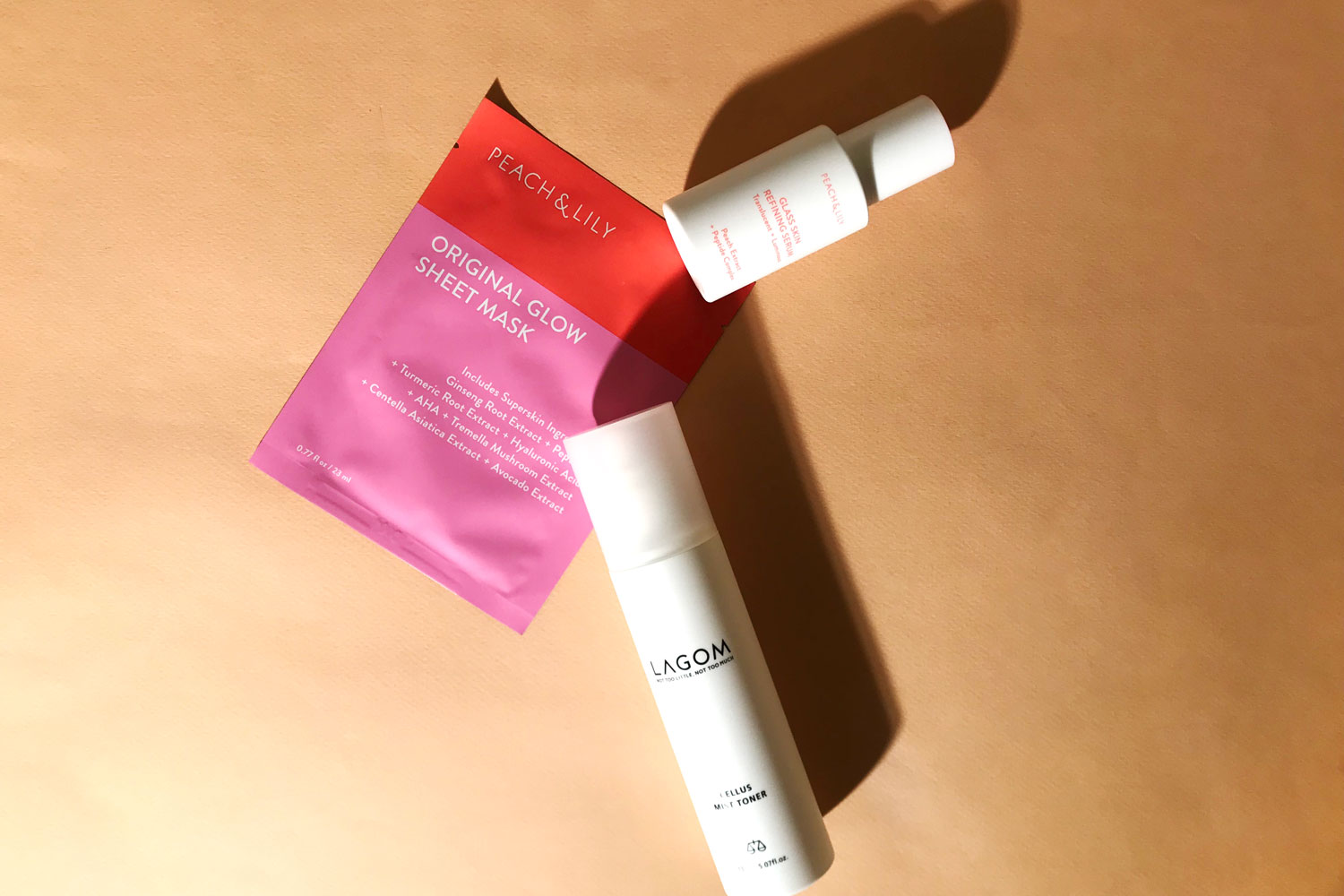
In the morning, I started as I usually do with a shower, cleansing my face using Glossier’s Milky Jelly Cleanser (my holy grail cleanser). Once out of the shower, I towelled dry, then spritzed Lagom’s Mist Toner liberally over my face — I’m not usually the biggest fan of mists, but I actually really love this one. The particles aren’t too fine, and the toner is cooling and hydrating, so my skin feels nice and balanced and hydrated.
After liberally spritzing my face, I patted the toner into my skin then went on to sheet masking. A week or so ago, I’d done Abib’s Gummy Sheet Mask Milk Sticker and absolutely loved it — it’s a mask that sticks to your face and has been soaked not in an essence but in a cream, which makes it super hydrating and nourishing — so I opted for Abib’s Gummy Sheet Mask Heartleaf Sticker. It was hydrating and calming, just what my skin needed after a cross-country flight (and no skincare routines to speak of), and, because it sticks so closely to the face, I was able to cook some breakfast and feed my puppies bits of egg and ham while my skin soaked in the soothing essence.
I always make sure to follow any sheet masking session with the rest of my skincare — I’m currently using the Peach & Lily Glass Skin Refining Serum and the Krave Beauty Great Barrier Relief as treatments. After watching Alicia, my boss, demonstrate her facial massage technique at the launch event for our Power Calm Hydrating Cleanser a few weeks ago, I’ve been taking the time to give myself a short facial massage every time I apply the Glass Skin Refining Serum.
Finally, I finished my “post-flight” routine by sealing everything in with the Peach & Lily Matcha Pudding Antioxidant Cream, which always leaves my skin dewy but also matte, and, of course, followed that with a sunscreen I’m currently testing.
—
LA is drier than New York, and I always feel like I’m kind of shriveling up when I’m there. It was also super windy in my parents’ neck of LA, so, to compensate for that extra dryness, I also did a hydrating sheet mask every day I was in town (it was only four days) to make sure my skin got the hydration and nourishment it needed. I took the Peach & Lily 3 Sheet Mask Set with me because I wanted sheet masks with a lighter, refreshing, hydrating essence — sometimes, if I do too many sheet masks with a heavier essence, my skin will start to break out.
As usual, I always followed my sheet masks with the Glass Skin Refining Serum, Great Barrier Relief, Matcha Pudding Antioxidant Cream, and a sunscreen. The daily sheet masking really helped keep my combination skin hydrated and healthy; I don’t know that my skin has ever been this soft before (not counting after an intensive facial).
—
Before my red-eye back to New York, I again … did not do a pre-flight routine; it was more important to get as many puppy cuddles as I could.
I also did not do a post-flight routine once I got to my apartment in Brooklyn at six a.m., collapsing in bed instead for a short nap before getting ready for work. Later in the day, though, at the office, I went through my routine — cleansing with the Power Calm Hydrating Gel Cleanser, toning with our Good Acids Toner, and doing one of our Original Glow sheet masks, which helped reset, calm, and nourish my tired skin after an exhausting red-eye.
As usual, I followed up the sheet mask with the Glass Skin Refining Serum (applied with a short facial massage), the Matcha Pudding Antioxidant Cream, and another sunscreen I’m currently testing, and my skin has been the happiest it’s been after traveling — so I suppose the point of all this is that, sometimes, it’s hard to do your pre- and post-flight routines because of life and because your flight lands at a terrible hour, and that’s okay. No one here’s going to shame you for not being obsessive about your pre- and post-flight routines. Just make sure to do them as soon as you’re able and to take into account the environment of wherever you are or will be, so your skin stays healthy, hydrated, and happy!
You might’ve had the experience where you apply your foundation over primer/moisturiser/sunscreen etc., and then a little while later your foundation’s gone clumpy. This is foundation incompatilibility. What’s happening, and what can you do to avoid it? Let’s talk about the science behind foundation! [Note: I would recommend watching the video in addition to reading…
With a clientele that includes royalty and celebrities from Europe and beyond, Dr. Timm Golueke is in high demand.
The German dermatologist is renowned for his expertise in lasers, injectables and cutting-edge treatments like PRP [platelet rich plasma] therapy. However, he’s not just a cosmetic doctor—he also treats acne, rosacea, allergies and other skin conditions.
So when he went to develop his own skincare products, his reputation was on the line. They HAD to work!
After years of research and testing, he finally launched Royal Fern, a minimalist, gender-neutral range based around a surprisingly humble ingredient: the fern.
Who would have thought that a common houseplant had powerful anti-aging benefits?
But it does—so much so that Dr. Golueke successfully patented the Royal Fern active ingredient complex, which is all-natural and infused in every product. Now, you can find the line worldwide at retailers such as Neiman Marcus, Violet Grey and Canada’s Holt Renfrew.
I sat down with Dr. Golueke during his recent Canadian visit to find out more about Royal Fern and to learn his tips for healthy, youthful skin!
What’s your background?
I’m the man behind Royal Fern, but I’m also a dermatologist. I’ve had my clinic in Munich for 15 years, doing not only aesthetic procedures but also general dermatology.
Do you still have an active dermatology practice?
Yes.
What area of expertise are you most known for?
I am known for laser therapy. We have one of the biggest laser centres in Munich. I’m also known for general dermatology. I started when there was no Botox and no fillers.
I would say that today, aesthetic medicine is about 50 percent of the procedures I am doing. It’s Botox, it’s filler, it’s PRP, it’s laser, it’s peels. We have cosmeticians in our clinic who do procedures like microneedling.
The other 50 percent is general dermatology for all ages and genders. Everything from eczema to mole checks to alopecia.
Dr. Timm Golueke at his clinic in Munich, Germany. (Photo: @royalfernskincare)
It seems like a lot of derms only want to do the aesthetic procedures now, since they’re so lucrative. Have you noticed that?
Yes, it’s very hard to find a derm who still does general dermatology. I get a lot of people not only from Munich, but who come from Switzerland, Austria and London to get classical dermatological advice.
Here, even family doctors and dentists are offering Botox.
Yes, everyone does it. It’s not good that the Botox companies sell it to every doctor. It is destroying the procedure. It’s a little bit like liposuction, which got destroyed. At one point, a lot of doctors did weekend courses because they thought it would be an easy way to make money. But it’s still a human body that you are treating, and it’s a medical procedure and there are risks.
With Botox, there is also a risk. And there is a risk that you don’t like it. I don’t like the fact that some people consider it “easy.”
Would you agree that it’s always best to get Botox or fillers done by a dermatologist, not a nurse?
Yes, you are totally right. The big difference between aesthetic procedures in the States and Canada versus Germany is that [in Germany,] nurses are not allowed to do them. Botox is prescription only. To get it you need to be a doctor, and to provide it to patients, you need to be a doctor.
It seems like Germany is having a real moment in skincare right now. I recently interviewed one of your colleagues, Dr. Barbara Sturm, who also has an anti-aging line.
But she is not a dermatologist. Anyway, yes, Barbara is also a German doctor. I think German medicine is very well known because it is clear. So talking about me, for example, I am very straightforward about what I think would be the best solution for the problem, and I explain this to the patient very clearly.
Germans are very direct.
Sometimes it’s too direct! It depends on the patient.
We might be offended?
Yes. Sometimes I am, too! But German medicine, it has a good reputation and people trust German science. Of course, we have to make money but it is not only money-driven. I would never recommend a procedure or test if I already know what the cause is.
Do you have a lot of celebrity patients?
Of course, but you’re not allowed to mention those. It’s a doctor’s secret by law. But I have a lot, [such as] royal families from the Middle East. That’s why I’m also going to Dubai from time to time.
Dr. Timm Golueke testing a new “aqua dermabrasion” machine at his clinic. (Photo: @royalfernskincare)
What’s the most common skin concern amongst your patients?
I would say it’s impurities and acne breakouts.
Adult acne?
Through all ages. People think that it can only happen in our teens, but you can also have this when you are older. Many things can lead to impurities. It can happen because of hormone disfunction, because of over-treatment of the skin, because of perioral dermatitis, or because of too much vitamin B.
Or it can happen because you use the wrong skincare. [The right products] are something you need daily.
I always got the impression that dermatologists don’t want to talk about over-the-counter skincare products—like that is not serious enough to trouble them with.
Yes, you are right. But it’s a daily business of a dermatologist that people come and ask what creams they should use. A lot of people just don’t know. They get recommendations from the media, from girlfriends. They spend money, but they’re lost in beauty heaven. If you go to a store, it can be very hard to find someone who really gives you honest advice.
So whenever someone comes to me, I always ask, “What products are you using now?” And when they make the first appointment, I always ask our patients to bring their current skincare routine to look over it. Some of them bring tons of stuff [that was] so much money. I feel bad when I see that and they still don’t look better, skin-wise.
When you look at their products, are you mainly checking the ingredients?
Not to sell, just to see if this is right. For example, if you have rosacea, then a high percentage of vitamin A or a fruit acid peel might not be the right thing.
Often people think they have acne, but it’s rosacea. They’re using peels, Clarisonic brushes and other devices, and it gets worse, worse, worse. Even educated people do this.
They get too aggressive.
Often they do too much. So no, patients should not be afraid to ask their dermatologists about skincare products. Not at all.
Is that what got you thinking about launching your own skincare line, after seeing what your patients were using?
Yes, exactly. This was the idea of creating a skincare line, because the demand was there. This was seven years ago.
Dr. Timm Golueke at Holt Renfrew in Toronto, Canada. (Photo: @royalfernskincare)
Why did you decide to base it around the fern?
Well, doing a skincare line is a big thing. You need to have someone who does it with you, because even though I am a dermatologist—even though I know about skin types and ingredients—I do not know how to do a cream. So I decided to [collaborate with] a German professor and biochemist, Dr. Leonhard Zastrow, who holds more than 500 patents for the industry.
I was looking for an ingredient that I believed in, and in our search, I came across a study out of Memorial Sloan Kettering Cancer Center in New York. They were using fern as a supplement for melanoma patients, because fern is protecting the cell DNA from UV rays.
So then we started to think about the fern more and more.
I’ve never heard of fern having skincare benefits until now.
Right, fern is a new ingredient for us. We’ve never really thought about the fern as having anti-aging properties. But actually, it has a long history of use in traditional medicine all over the world. Ferns have been used for centuries to heal eczema, inflammations and skin diseases.
For example, when my Russian patients first saw [Royal Fern] in my clinic, for them it was nothing new. They use the leaves for eczema and wounds because the fern is so anti-inflammatory. In Latin America, they also use fern extract in creams for eczema.
Due to the anti-inflammatory properties, of course, it is working against aging skin. Because what is aging? It’s a chronic inflammation, nothing more.
How does fern protect the cell DNA?
Fern is highly antioxidative. I was in Korea recently, and the monks there cook teas out of fern leaves because of the antioxidant properties. So if you go to the supermarket in Seoul, you can buy fern leaves.
And it’s slightly brightening, because it is inhibiting production of pigment.
If you think about it, the fern is everywhere, sometimes even on the street. It’s evergreen and resistant to sunlight. I think it’s a beautiful plant, but in most people’s minds, it’s not a very elegant plant because it’s all over.
It’s common.
It’s one of the first plants that came from the ocean to the land, so there must be something to why the fern is so common and so resistant to everything.
Royal Fern Phytoactive Anti-Aging Cream. (Photo: @m.sik)
And now you hold a patent on it, correct?
I hold the patent on the Royal Fern Complex, which is five ingredients. We were looking for other ingredients to strengthen the power of the fern. All the products contain the Complex and I have the patent for 20 years on that.
What are the five ingredients in the Complex?
The fern extract; we use the leaves and the roots. Then we combine it with Voacanga seeds, which are from an evergreen tree in Africa. We also use wild rose blossoms because of the vitamin C, sea buckthorn for moisture, and mineral oxides because they reflect and protect from UV light. The mineral oxides also give a blurring effect, but we didn’t choose them for that reason.
Besides using fern, how would you say Royal Fern is different to other medical skincare brands?
Yes, we are the only skincare line using fern, so it’s very unique. I think it’s also [that I am] a dermatologist. There are a lot of plastic surgeons [with skincare lines] on the market, but where does the expertise come from?
Everything is done by us. It’s made in Germany, in Bavaria, and it’s hand-filled. We test all the products and everything goes through my hands.
Sometimes, it’s really stressful. It takes us at least one year to create a new product. Retailers will say, “Oh, we need this!” But it’s not so fast. We have to do all the testing.
If you had to pick just one, which product should people try?
I think maybe start with the Cream. That’s the hero product. It contains the Complex, of course. It contains peach extracts, a mild form of vitamin A, hyaluronic acid and vitamin C out of an Acerola cherry.
Not for someone who needs to be on Accutane, of course. But if you have impurities from time to time, it helps with that because [the fern] reduces inflammation. But you should see your dermatologist to see why it’s happening in the first place.
It feels really light. Not oily.
It’s super light. It’s free of mineral oils and it goes in fast.
Any silicones?
No dimethicone. The only product where we have it is in the Eye Cream, to cover the ingredients to get in.
Because otherwise it will migrate?
Yes, but that’s the only product. And no mineral oils, no parabens, not tested on animals and vegan.
Do you use fragrance? A lot of people are trying to avoid fragrance these days.
We use a light fragrance, not in the Eye Cream but all the other creams. It’s done by a perfumer; it’s a gender neutral fragrance that goes away very fast.
It was important because I have patients who used [other] creams, and their husbands, boyfriends, girlfriends, whatever next to them at night would say, “I don’t like the smell.” So people had to like it.
Is it a natural fragrance?
No, it’s not.
But it won’t harm your skin?
No, it’s not toxic.
Royal Fern Phytoactive Anti-Aging Cream, Serum and Anti Oxidative Ampoules. (Photo: @royalfernskincare)
And the line itself—you wouldn’t call it natural, would you?
It does have natural ingredients, but things like hyaluronic acid are not natural. So we couldn’t claim it was a natural skincare line. Everyone loves hyaluronic acid; I love it, too. It’s a gold standard, and it’s not natural.
Is everything natural necessarily better? No. Some of the worst allergies are caused by tea tree oil, or when people are allergic to nuts and get swollen lips.
I feel like we’re moving away from the idea of “natural is good” and “chemical is bad,” or vice versa. There are lots of brands that take the best of both worlds.
Right. When you don’t like chemicals, that’s fine. It’s the decision of the patient. But being a doctor, I cannot claim that something is working that is not working.
You also wanted to create products that anyone could use, correct?
Anyone. It’s gender neutral and also the packaging is gender neutral.
I don’t believe so much in the separation between men and women, old and young. I think it’s more about skin types. Some people need something richer, some people need something lighter.
I find most creams are too much for me.
The Cream would be perfect for you because you are more like me, the rosacea type. After we launched it, patients of mine came back and said their rosacea was better, because it is anti-inflammatory.
We also have a Rich Cream that might be too rich for you, or it might be good at night or in winter when you have a more sensitive skin type.
Royal Fern Phytoactive Anti-Aging Rich Cream
That doesn’t feel heavy either.
It goes in very fast, but the Complex is packed in liposomes so it slowly releases over 12 hours. It’s more for the customer who wants to have the rich, mineral oil-based creams, but this is mineral oil-free.
[Before my patients tried it,] they would say, “I like it but it’s not rich enough.” I said, “Wait, you will see tonight. Write me an email tomorrow and you will see that your skin is completely moisturized.”
Yes, for hydration. You would use it underneath your Cream. The Serum has long chain hyaluronic acid and the Complex in a higher percentage.
Royal Fern Phytoactive Anti-Aging Serum
Do you think eye cream is necessary?
Eye cream is very important. It’s where the wrinkles first appear, because of constant movement, and it’s the most sensitive area of the face.
Our Eye Cream contains chamomile for puffiness and a high percentage of vitamin C for dark circles. Plus the Complex, of course. You can also use it like an eye mask.
Royal Fern Phytoactive Anti-Aging Eye Cream
Dark circles are so hard to treat, aren’t they?
Yes, it’s really hard. There was one cream from Belgium [that worked] using vitamin K, but they took it from the market because people are not really sure if vitamin K could be carcinogenic.
What do you suggest for cleanser?
Soap-free and sulfate-free, like our Cleansing Balm. Soap and sulfates are not good for your skin. So it doesn’t strip your skin of its natural oils, and it’s also removing makeup.
It also contains a high percent of hyaluronic acid, green tea and cucumber. Some people only use this in summer, wash it off, and then SPF on top. Due to the hyaluronic acid, it’s already treating your skin.
Royal Fern Phytoactive Cleansing Balm
How important is sunscreen? I assume very important, being a dermatologist.
Very important. Even if it’s cloudy, [you should] wear it. Ideally SPF 50.
Sometimes, I’m confronted after people have a glass of wine, and they start asking you these questions about it. They say, “There’s this study, and people got even more melanoma after SPF.”
It was this famous study where one group used SPF and the other group didn’t. The group that was using SPF had a higher coincidence of melanoma.
I’ve heard of that study.
People always refer to it. But if you look it up, the study was of people who have been using SPF and are exposed to the sun. [They got melanoma because] either they had sensitive skin, like us, or they were working out or doing sports outside for years.
The other group, the people who didn’t use sunscreen, they were at home inside, in front of the TV. This is why [the researchers] used them—it’s not a study where they gave no SPF [and had them go outside].
Any plans to launch a sunscreen of your own?
No. It’s complicated because the regulations are different all over the world. I always recommend people go for the pharmacy stuff, like La Roche-Posay or Avène, because they [protect against] UVA and UVB.
There is also a very good company called ISDIN from Spain that we sell in our office, maybe you can find it on Amazon. I love it. You can use it around the eyes without irritating them. Often we forget, but it’s very important to wear sunblock around the eyes.
Do you think pharmacy sunscreens are more protective than something you’d find at, say, Sephora?
I think the more lifestyle-oriented brands should keep their fingers away from SPF. If you use our light Cream under an SPF from the pharmacy, it’s so much better than using a cream that already has an SPF in it, with all those add-ons. How do you know the percentage [of active ingredients] is as high as needed? We’re not only talking about wrinkles, but also melanoma and basal cell carcinoma, so it’s a medical thing.
Dr. Timm Golueke with a 2017 dermatology award. (Photo: @royalfernskincare)
What about exfoliation? Do you plan to have any exfoliating products in the line?
We will have a toner soon using gluconolactone.
That’s really gentle, right?
Yes, it’s a gentle version of fruit acid.
What do you think about acids in general? A lot of brands have been inspired by Lotion P50 lately.
Yes. We’re the only clinic in Germany that carries Biologique Recherche. So we do the treatments and [sell] the Biologique Recherche products. They’re really trustworthy, good products and P50 is the gold standard of toners.
So would you say that a mild blend of acids can be beneficial?
Alpha, beta and also milk acid, lactic acid. Yes, they are really proven. They can help with acne. They also induce the production of new collagen. They slightly exfoliate, which activates the natural cell turnover.
But there are also skin types that shouldn’t use acids, even from Biologique Recherche. P50 and even the lighter version, P50W, is not good for all skin types. No. For very sensitive skin or dry skin, it can be too strong. Around the eyes, it’s much too strong. It’s irritating. And it can make rosacea worse. I love them, and we are working with them, but it’s not for everyone.
Is there one ingredient that you do think everyone should use?
There is no one ingredient that is good for everyone. Maybe hyaluronic acid, because it’s only giving moisture. But even then, I don’t believe in products that only contain hyaluronic acid. You’ll always need it in combination with other ingredients—otherwise it adds an extra step, and most people in Canada, the States, Germany don’t do the Korean regimen with five steps.
Definitely not.
We do two steps. That’s it. So if you use one step for the hyaluronic acid product, where do you include the antioxidants?
Right. So antioxidants are very important, too.
We always think of the sun, but it’s also the daily air pollution. The dust that causes free radicals, which needs an antioxidant to neutralize them.
We have new ampoules, the Anti Oxidative Ampoules, that have riboflavin, green tea, grape extracts and vitamin C. It’s a daily dose that you can apply at night after sun exposure, like if you did sports or were with the children on the playground—whenever you went outside and need extra antioxidants. It’s a monthly supply, 15 in a box, so you can use one ampoule every other day for four weeks. Or you can use it whenever you need it.
Royal Fern Phytoactive Anti Oxidative Ampoules
Wouldn’t you want to use it every day?
You shouldn’t use it every day all year, because it’s really strong ingredients. I recommend either a three-month course or whenever needed. Also, it’s better to use it at night.
Why ampoules and not an antioxidant serum, like C E Ferulic?
With a serum, you open and reopen it, so you need a higher percentage of preservatives. [The Ampoules] need less preservatives, and contain an even higher percentage of [active] ingredients than our Serum. Also, the patient knows exactly how much to use—each ampoule is one dose. They’re easy to travel with. We don’t get sun during the week, but on the weekends, that’s perfect to take with you.
We also have the Illuminating Ampoules, which is a brightening product. It contains niacinamide, which is the most classical brightening ingredient, and vitamin C, which is reducing the production of pigment. Chlorophyll is leading to the production of collagen and gives it a green colour. Also, a new ingredient that I found in Korea last year, Asian lizard tail. Not the real tail of a lizard—it’s the plant that has that name that is inhibiting melanin production.
Royal Fern Phytoactive Illuminating Ampoules
How long does it take to start seeing results from a Royal Fern regimen?
You have to give your skin at least four weeks, because the normal cell turnover is four weeks.
To sum up, what would you say are the absolute essentials for healthy skin?
Moisture.
SPF in the morning.
An antioxidant—whatever one you choose, fern, CoQ10, vitamin C—to protect from free radicals.
Slightly exfoliating with retinol or acids to activate the natural cell turnover.
The activation of new collagen with retinol, vitamin C, polyphenols or fern.
Sleep. Seven to eight hours of sleep.
And you need to clean your skin because of urban pollution and dust. We always forget about that.
Should we be cleansing twice a day?
If you have sensitive skin and you take a shower in the morning, you don’t necessarily need a cleanser. The most important thing is to clean your face at night.
But if you come home after a big night out and you go to bed with makeup on once in a while, it’s also good, because beauty comes from the inside. You can’t be too neurotic about your routine!
What are the best skincare products with Granactive Retinoid?
In the past couple of years, this new form of retinoid (Vitamin A) got under the spotlight for its anti-aging superpowers. Fans say it gives you the same benefits as retinol without the side effects.
Me? I wouldn’t go that far. So far, all the studies that prove its wrinkle-fighting abilities come from the manufacturer. Call me sceptical, but I need more proof than that.
Having said that, I wouldn’t dismiss Granactive Retinoid like that. If you’re new to retinoids or have skin so sensitive it can’t tolerate retinol, Granactive Retinoid can be a good alternative.
If you’re a bit further ahead on your retinoid journey and can easily tolerate retinol, why not go for products that have both forms of vitamin A? I do it all the time.
Here are the best skincare products with Granactive Retinoid to get you started:
P.S. Granactive Retinoid is the nickname for hydroxypinacolone retinoate. Because, who the heck can remember that?!
Best Granactive Retinoid Serum For Beginners: Mad Hippie Vitamin A Serum ($32.99)
No matter what form of retinoids you’re using, I’m a big believer in starting with a small concentration and working your way up slowly. Mad Hippie Vitamin A Serum is the perfect place to start your retinol journey. It only has a few drops of hydroxypinacolone retinoate – just enough to work its magic but not enough to irritate your skin. Plus, the serum is loaded with moisture-magnets like hyaluronic acid that deliver a big dose of water into the skin and phytoceramides and natural oils to strengthen the skin’s protective barrier’s against irritants. Hello, smooth, soft skin!
Best Granactive Retinoid Serum For Sensitive Skin: The Ordinary Granactive Retinoid 5% In Squalane (£11.90)
The Ordinary Granactive Retinoid 5% In Squalane keeps it simple. It only has 7 ingredients, including granactive retinoid and Squalane. That’s good because every ingredient you add to a skincare product has the potential to cause another flareup in sensitive skin. Granactive retinoid keeps wrinkles at bay while Squalane provides a moisturising base that keeps skin soft and smooth. If retinoid serums – or anything else for that matter – makes your skin throw a tantrum, give this one a go. Seriously, if you can’t tolerate this, retinoids are NOT for you.
Best Granactive Retinoid Serum On A Budget: The Ordinary Granactive Retinoid 2% Emulsion (£8.00)
Hydroxypinacolone retinoate doesn’t play solo here. The Ordinary Granactive Retinoid 2% Emulsion also has microencapsulated retinol, making it more powerful (and harsher) than the serums above. If you’re ready to upgrade, this is a great – but basic – option to consider. The two forms of retinol smoothen out wrinkles. Bisabobol and Tasmanian pepperberry soothe skin, making retinol more tolerable. Glycerin and a coconut oil derivative moisturise skin, counteracting any dryness from the retinol. What’s missing? The oily base of the other The Ordinary retinoid products. If you can’t stand that, you’ll love this emulsion.
Best Natural Granactive Retinoid Oil: Pestle & Mortar Superstar Night Oil (£68.00)
If you prefer to use all natural skincare products, get your hands on Pestle & Mortar Superstar Night Oil. This baby uses two forms of retinoids – retinol and hydroxypinacolone retinoate – to smoothen out wrinkles and brighten the complexion. The rest of the formula is made up of a bunch of natural oils with moisturizing and antioxidant properties: they counteract the drying side effects of retinoid and help it fight off the free radicals that give you wrinkles. The best part? Pestle & Mortar has stayed away from citrus, lavender, sandalwood and all those fragrant oils that can irritate sensitive skin. Bravo!
Best Granactive Retinoid Cream For Antiaging: Indeed Labs Retinol Reface (£19.90)
Indeed Labs Retinol Reface is one of the most powerful retinoid products I’ve ever tried. Powerful in skincare means MORE effective – but also potentially MORE irritating. You’ve guessed, this isn’t for newbies. You have to work your way up the retinol scale before you’re able to use this one. But it’s worth it. It has 3 forms of retinoids: hydroxypinacolone retinoate, retinol and Palmitoyl oligopeptide, a retinol-like peptide that boosts collagen production. They’re nestled into a silicone base that helps the product glide smoothly on your face. The only con? It has no soothing agents to counteract the irritation and dryness from retinol. That’s why you need to be a pro to use it.
What do you think are the best skincare products with granactive retinoid? Share your picks in the comments below.
Take The Guesswork Out Of Skincare Shopping
Get access to the “Pro Skincare Library” for exclusive skincare routine “cheat sheets” and tricks to help you navigate the beauty aisles jungle like a pro and immediately know what to pick off the shelves to achieve the gorgeous skin of your dreams – even when you’re drowning in an endless sea of skincare products.
Success! Now check your email to confirm your subscription and get access to the skin library.
I’m not fussy when it comes to Rosehip oil. Any brand will do.
Or did. Until now. Cos the unthinkable has happened. I’ve found a bottle of Rosehip oil I’m not too fond of.
I’m talking about Pai Rosehip BioRegenerate Oil. I know a lot of you love it – and it IS a good oil. It just has a little flaw that doesn’t agree with my skin. Here’s what I mean:
Key Ingredients In Pai Rosehip BioRegenerate Oil
Rosehip Oil
Pai Rosehip BioRegenerate Oil uses both the fruits and seeds of the rosehip (the the radish-like ball roses leave behind after they blossom) for a double dose of goodies. Here’s what they do:
If you’re looking for an anti-aging oil that goes the extra mile, rosehip oil IS it.
I’m sure you know that vitamin E and rosemary are powerful antioxidants that help you prevent premature wrinkles.
But I doubt that’s why they’re in Pai Rosehip BioRegenerate Oil. There are only a few drops of them here so don’t expect them to do too much for wrinkles.
But that doesn’t make them useless. Here, they act as preservatives: they make the rosehip oil last longer than it would on its own.
Pai Rosehip BioRegenerate Oil has a deep, earthy scent that’s a bit of an acquired taste. If you’re into your light florals, you probably won’t dig this. The plus side? The earthy scent’s a sign the oil is high quality.
You know what else signals this oil is the real deal? The deep orangey colour. As a rule, the deeper the hue, the more antioxidants and goodies the oil contains.
You’d think this’d be great news for my skin… but the deep orange hue is wy they don’t get along. You see, Pai Rosehip BioRegenerate Oil stains my skin yellow when I apply it. Ugh.
Maybe I could have put up with that but… the thick texture takes a while to absorb. You guessed it, if I go to bed before it has fully sunk in, it stains my pillow too.
I may be a skincare junkie… but I’m a lazy one at that. I don’t want to deal with stains, laundry and long absorption times. Sorry, Pai!
If you don’t mind about these little drawbacks, the oil works wonders. I put it on before I go to sleep at night. When I wake up in the morning, my face looks plumper, feels smoother to the touch and is a little brighter.
I can’t vouch for how well it treats acne or dark spots because I don’t have any (lucky, I know). Just be aware that Rosehip oil isn’t the miraculous treatment brands make it out to be.
I’ve heard it said it can treat stretch marks, scars and who knows what else. There’s just no proof for that. What it does is moisturise skin, help reduce acne and – in the long run – keep wrinkles at bay. And that’s a lot, if you ask me.
Ingrediens: Rosa Canina Seed Extract, Rosa Canina Fruit Extract, Tocopherol, Rosmarinus Officinalis Leaf Extract
Have you tried Pai Rosehip BioRegenerate Oil? Share your experience in the comments below.
Affiliate links.
Take The Guesswork Out Of Skincare Shopping
Get access to the “Pro Skincare Library” for exclusive skincare routine “cheat sheets” and tricks to help you navigate the beauty aisles jungle like a pro and immediately know what to pick off the shelves to achieve the gorgeous skin of your dreams – even when you’re drowning in an endless sea of skincare products.
Success! Now check your email to confirm your subscription and get access to the skin library.
When she found out she was pregnant, Dr Justine had to tweak her skincare routine. Gone were staples like retinol that kept both wrinkles and acne at bay. Now she had to find a new way – one that’s safe for both mum and baby – to keep her acne from flaring up again.
In this interview, Dr Justine Kluk shares her secrets to deal with acne during pregnancy – and how to keep skin clear and youthful as you get older:
1. When did you become interested in skincare?
I have always loved the idea of working closely with other people and helping to make their lives better so a career in medicine was on the table from a very early age. My interest in the skin stems from my own personal experience with acne from the age of twelve right up until my late twenties. As a qualified doctor by that stage, I was determined that others shouldn’t endure the embarrassment and loss of self-esteem I suffered. I doubled my efforts and secured a place on the highly competitive dermatology specialist training programme so that I could become a Consultant Dermatologist.
These days, I am in the privileged position of being able to look after people with similar experiences to mine in my clinic. It is enormously satisfying to be able to reassure people with skin concerns that there is treatment that can work and to watch the change in demeanour as their skin improves and their confidence returns.
As both a medical and cosmetic dermatologist, I am lucky to be able to see my patients through their entire skin journey. This means that I may treat somebody for acne in their teens or twenties. When this is under control, we may decide to tackle any scars or discolouration left behind. They may then come back to me down the line for advice about stretchmarks or skincare after pregnancy, to treat eczema in their little ones or to discuss options for reducing wrinkles and preventing premature skin ageing later on.
2. What’s your skincare routine like?
My skincare routine has changed quite a bit over the past few months as I’m expecting a baby in a few weeks’ time! This means that some of my usual go-to products, such as retinol, have been put on pause for the time being. My acne has also flared up during the pregnancy so I’ve adapted my routine as safely as I can to try and keep breakouts at bay (and keep my skin looking young and fresh) without posing any risk to the baby.
I use a mild gel or cream cleanser in the morning, such as Avene Extremely Gentle Gel Cleanser or Cetaphil Gentle Skin Cleanser. I squeeze a 10 pence sized blob into my hands and massage into wet skin with clean fingertips before patting dry gently. I don’t use a grainy scrub or any devices to exfoliate my skin as these increase redness and swelling from inflamed spots.
I follow with Skinceuticals Phloretin CF antioxidant serum, spreading 4-5 drops over my entire face, neck and decollete. It’s important to me to maintain the anti-ageing component of my skincare routine during pregnancy and vitamin C based antioxidants help reduce collagen breakdown that leads to skin sagging and wrinkle formation. They also help regulate skin pigmentation which can become problematic in pregnancy. I find that many serums are oily and exacerbate acne, but this one doesn’t.
I am currently applying a prescription strength azelaic acid cream next in the mornings. Azelaic acid reduces pore clogging and also has a direct anti-inflammatory effect, so can be helpful for keeping spots in check. It should only be used after consultation with a Consultant Dermatologist in pregnancy to weigh up the benefits and risks and ensure it is safe for the baby.
I follow this with a broad spectrum UVA/ UVB SPF30 or 50, such as Jan Marini Physical Protectant or Heliocare XF gel. Having completed a fellowship in skin cancer after finishing my Dermatology specialist training, I am very careful about protecting my skin from UV radiation all year round to reduce my skin cancer risk and prevent premature skin ageing.
In the evenings, I remove my makeup with Bioderma Sensibio micellar water or Garnier micellar cleansing water for sensitive skin and follow this with the same cleanser I use in the morning. As retinol and other vitamin A based creams are off limits during pregnancy, I am currently using a glycolic acid product in the evenings instead. My go-to is Skinceuticals Glycolic 10 Renew Overnight. I apply a pea sized amount to my face, avoiding the area directly around my eyes, and another pea sized amount to my neck and chest. Glycolic acid brightens and smooths my skin and helps reduce fine lines and wrinkles.
I leave the glycolic acid to soak in for 15-30 minutes and then apply Medik8 Liquid Peptides generously all over my face, neck and decollete for it’s hydrating, collagen boosting, skin plumping benefits. I don’t use a separate eye product at present because peptides are great for rejuvenation around the eye area as well.
3. If you could only use three skincare products for the rest of your life, what would they be?
The 3 most important skincare products in my book are sunscreen, retinol and a vitamin C-based antioxidant serum.
4. What are your fave skincare brands and why?
La Roche Posay and Avene for excellent, fuss-free staples like cleanser and moisturiser.
Bioderma for the original and best micellar water. It’s magic for removing makeup in the evenings.
Ambre Solaire for their huge selection of sunscreens to suit every age and stage of life. I actually work with them on their sun awareness campaigns every year.
Skinceuticals for their antioxidant serums. They’re pricy, but hands-down the best I’ve ever used.
5. What are your top 3 skincare tips to take care of your skin?
Wear sunscreen religiously. Apply SPF30 or 50 to exposed skin every morning come rain or come shine. Wear a hat if you’re in direct sunlight for prolonged periods and top up your protection every couple of hours if you’re spending the day outdoors and after swimming, sweating or towelling off. After genes, sun exposure is the most important factor in the skin ageing process and it’s easy to avoid if you take appropriate steps.
Keep it simple. It is so easy to end up with confused, congested and irritated skin if you chop and change your skincare products all the time and don’t allow them enough time to work. The same goes for trying to combine too many different ingredients into a routine. A few key items will do – you don’t have to use EVERYTHING just because you can.
Seek expert help early if you’re suffering with a skin problem. My particular areas of clinical interest are acne and rosacea and I see so many people in my clinic who have been struggling with a visible skin concern on their own, or with little support from previous doctors, leading to loss of confidence and poor body image. Undertreated acne can also cause permanent scars so my best advice is that if you are not seeing improvements with over the counter products or prescriptions from your GP, a Consultant Dermatologist is the best qualified doctor to help with your skin concerns.
6. What skincare treatments do you regularly have done?
Microneedling is an effective, low risk and minimal downtime option for boosting collagen production. Not only does it help with rejuvenating ageing skin, it is also an excellent option for improving acne scarring and it is easily one of my favourite treatments.
I’m not having any injectable treatments at present because I’m pregnant, however I have had botulinum toxin treatment over the past 2-3 years to reduce my crow’s feet, forehead wrinkles and also to improve my gummy smile. I have small doses only, with the intention of reducing, but not completely freezing muscle movement, so that I still look like me but am not repeatedly weakening the skin and deepening creases every time I squint, smile or frown.
I’ve had my eyebrows microbladed and have also had laser hair removal in the past. These were both complete game-changers for me in terms of time saving. I haven’t had to wax or shave my legs or underarms for years , which means I am holiday ready at all times, and I don’t have to agonise every morning about neatly pencilling my eyebrows in. The eyebrow treatment does need to be topped up every year or two to maintain the result.
7. What lifestyle habits do you have that keep your skin in top shape?
I wear SPF every day on exposed skin between April and September, and all year round on my face.
I take a vitamin D supplement every day so that I don’t have to worry about developing a deficiency as a result of keeping out of the sun.
I cleanse my skin twice daily without fail and always remove my makeup before bed or working out. A small bottle of micellar water and a few cotton pads on my bedside table and in my gym bag mean that I’m never tempted to skip this.
I remove my gym gear and shower as soon as I possibly can after exercise. This helps to prevent the dreaded “bacne”.
I am wrinkle conscious and carry around a pair of sunglasses in my handbag to avoid having to squint in brighter weather as this deepens and extends crow’s feet prematurely.
8. What’s in your makeup bag?
BareMinerals SPF20 correcting concealer for under my eyes. It’s lightweight and creamy so hydrates the dry skin below my eyes and doesn’t get stuck in the creases.
Colorescience Sunforgettable SPF50. It’s a handy brush-on mineral powder that mattifies, gives a bit of light coverage and also protects from the sun. I dust this on after applying my sun protection moisturiser and concealer. I also sometimes use BareMinerals SPF25 mineral veil as an alternative.
Nars bronzing powder in Laguna. The only way to get a healthy tan in my opinion. I use it to add contour to my cheeks and jawline and love the shimmery glow it gives my skin. People always ask if I’ve been on holiday.
Laura Mercier Second Skin cheek colour in Rose Bloom. This creates a very natural-looking bush and I use it to emphasise the apples of my cheeks. Drawing attention to this part of the face is said to give a more youthful appearance.
Charlotte Tilbury Full Fat Lashes. This is the first mascara I’ve found that gives really dramatic, fluttery lashes without forming clumps or drying up and falling onto my cheeks. I’ve also been using a Skinceuticals eye cream (A.G.E Eye complex) to slow the signs of ageing around my eyes and a co-incidental perk has been that my eyelashes have grown super long at the same time!
Blink Brow Bar London Ultimate Arch Definer in Cinnamon. I have very patchy eyebrows from years of over plucking as a teenager. Microblading has made the biggest difference and my eyebrows frame my face much better now. All I need is a touch of brow pencil to keep the shape defined. You wouldn’t believe how many compliments I get!
Mac Lustre lipstick in Hug Me or Jubilee. I prefer a nude or pinkish-beige lip colour and need something nourishing, that glides on easily and gives a bit of shine, as my lips are very prone to being dry. These 2 shades are my absolute favourite for every day, but I do like a bolder red lip if I’m heading out for the evening or want to make more of a statement.
Get access to the “Pro Skincare Library” for exclusive skincare routine “cheat sheets” and tricks to help you navigate the beauty aisles jungle like a pro and immediately know what to pick off the shelves to achieve the gorgeous skin of your dreams – even when you’re drowning in an endless sea of skincare products.
Success! Now check your email to confirm your subscription and get access to the skin library.


 You might’ve had the experience where you apply your foundation over primer/moisturiser/sunscreen etc., and then a little while later your foundation’s gone clumpy. This is foundation incompatilibility. What’s happening, and what can you do to avoid it? Let’s talk about the science behind foundation! [Note: I would recommend watching the video in addition to reading…


 Dawn Siler